Friday, 30 March 2018

Facebook’s mission changed, but its motives didn’t

In January, Facebook announced that it would be changing its feed algorithm to promote users’ well-being over time spent browsing content. That’s a relatively new approach for a company whose ethos once centered around “move fast, break things.”

It wasn’t all that long ago (approximately a year and a half before the algorithm change) that Facebook VP Andrew “Boz” Bosworth, published an internal memo called “The Ugly,” which was circulated throughout the company. In it, Boz made it clear to employees that connecting people (i.e. growth) is the main focus at Facebook, at all costs.

Buzzfeed first published the memo, which said:

Maybe it costs a life by exposing someone to bullies. Maybe someone dies in a terrorist attack coordinated on our tools.

And still we connect people.

The ugly truth is that we believe in connecting people so deeply that anything that allows us to connect more people more often is *de facto* good. It is perhaps the only area where the metrics do tell the true story as far as we are concerned.

He goes on:

That isn’t something we are doing for ourselves. Or for our stock price (ha!). It is literally just what we do. We connect people. Period.

That’s why all the work we do in growth is justified. All the questionable contact importing practices. All the subtle language that helps people stay searchable by friends. All of the work we do to bring more communication in. The work we will likely have to do in China some day. All of it.

Facebook launched in 2004 and ushered in a honeymoon period for users. We reveled in uploading photos from our digital cameras and sharing them with friends. We cared about each and every notification. We shared our status. We played Farmville. We diligently curated our Likes.

But the honeymoon is over. Facebook grew to 1 billion active users in 2012. The social network now has over 2 billion active users. A growing number of people get their news from social media. The size and scope of Facebook is simply overwhelming.

And we’ve been well aware, as users and outsiders looking in on the network, that just like any other tool, Facebook can be used for evil.

But there was still some question whether or not Facebook leadership understood that principle, and if they did, whether or not they actually cared.

For a long time, perhaps too long, Facebook adhered to the “Move fast, break things” mentality. And things have certainly been broken, from fake news circulated during the 2016 Presidential election to the improper use of user data by third-party developers and Cambridge Analytica. And that’s likely the tip of the iceberg.

The memo was written long before the shit hit the fan for Facebook. It was published following the broadcast of Antonio Perkins’ murder on Facebook. This was back when Facebook was still insisting that it isn’t a media company, that it is simply a set of pipes through which people can ship off their content.

What is so shocking about the memo is that it confirms some of our deepest fears. A social network, with a population greater than any single country, is solely focused on growth over the well-being of the society it’s built. That the ends, to be a product everyone uses, might justify the means.

Facebook has tried to move away from this persona, however gently. In late 2016, Zuckerberg finally budged on the idea that Facebook is a media company, clarifying that it’s not a traditional media company. Last year, the company launched the Journalism Project in response to the scary growth of fake news on the platform. Zuckerberg even posted full-page print ads seeking patience and forgiveness in the wake of this most recent Cambridge Analytica scandal.

While that all seems like more of a public relations response than actionable change, it’s better than the stoic, inflexible silence of before.

After Buzzfeed published the memo, Boz and Zuckerberg both responded.

Boz said it was all about spurring internal debate to help shape future tools.

Zuck had this to say:

Boz is a talented leader who says many provocative things. This was one that most people at Facebook including myself disagreed with strongly. We’ve never believed the ends justify the means.

We recognize that connecting people isn’t enough by itself. We also need to work to bring people closer together. We changed our whole mission and company focus to reflect this last year.

If Boz wrote this memo to spark debate, it’s hard to discern whether that debate led to real change.

The memo has since been deleted, but you can read the full text below:

The Ugly

We talk about the good and the bad of our work often. I want to talk about the ugly.

We connect people.

That can be good if they make it positive. Maybe someone finds love. Maybe it even saves the life of someone on the brink of suicide.

So we connect more people

That can be bad if they make it negative. Maybe it costs a life by exposing someone to bullies. Maybe someone dies in a terrorist attack coordinated on our tools.

And still we connect people.

The ugly truth is that we believe in connecting people so deeply that anything that allows us to connect more people more often is *de facto* good. It is perhaps the only area where the metrics do tell the true story as far as we are concerned.

That isn’t something we are doing for ourselves. Or for our stock price (ha!). It is literally just what we do. We connect people. Period.

That’s why all the work we do in growth is justified. All the questionable contact importing practices. All the subtle language that helps people stay searchable by friends. All of the work we do to bring more communication in. The work we will likely have to do in China some day. All of it.

The natural state of the world is not connected. It is not unified. It is fragmented by borders, languages, and increasingly by different products. The best products don’t win. The ones everyone use win.

I know a lot of people don’t want to hear this. Most of us have the luxury of working in the warm glow of building products consumers love. But make no mistake, growth tactics are how we got here. If you joined the company because it is doing great work, that’s why we get to do that great work. We do have great products but we still wouldn’t be half our size without pushing the envelope on growth. Nothing makes Facebook as valuable as having your friends on it, and no product decisions have gotten as many friends on as the ones made in growth. Not photo tagging. Not news feed. Not messenger. Nothing.

In almost all of our work, we have to answer hard questions about what we believe. We have to justify the metrics and make sure they aren’t losing out on a bigger picture. But connecting people. That’s our imperative. Because that’s what we do. We connect people.


from Social – TechCrunch https://ift.tt/2E7sX4Y Read More Detail!

Netpeak Spider


Netpeak Spider is a desktop tool which crawls your website like a search engine robot and detects key SEO issues that influence the website’s visibility in SERP. Netpeak Spider is available on Windows and Mac OS (10.11 and higher).

View startup


from BetaList https://ift.tt/2GIePVq Read More Detail!

StockedKitchen


Stocked Kitchen is an app that focuses on food. Write and save your own recipes, select them, get a customised shopping list. We understand the importance of shopping lists and the annoyance of making them. We want people to focus more on what they want to eat and less on what they need to buy. We find that this helps us eat better, and save money by saving the recipes we like better and simply scroll through them and select them.

View startup


from BetaList https://ift.tt/2GkpZAg Read More Detail!

HappyTask


HappyTask allows you to explore tasks (shared by fellow HappyTaskers) that have brought about happiness by completing. Whether it be something simple, such as “do a push up”, or something major like “rent a vespa and ride through Tuscany”; HappyTask is a tight-knit community built for people to share ideas and inspire others to get off the couch and DO fun, insightful, and meaningful things!

View startup


from BetaList https://ift.tt/2GlZKcV Read More Detail!

CleepCam


CleepCam is a machine-learning enabled camera that teaches the camera by using an intuitive image gallery user interface where users can upload a photo of who you want it to recognize. Get personalized alerts, not motion detection alerts and eliminate false notifications.

View startup


from BetaList https://ift.tt/2pQBowA Read More Detail!

Thursday, 29 March 2018

TravelVoc


TravelVoc is designed for smart travellers of any kind (solo, with family or friends) who would like an extra layer of confidence while overseas. Our app allows users to make calls to over 800 customer service numbers without incuring international roaming fees, all listed on an up-to-date travel directory.

The numbers in our directory include hotels, travel agencies, hospitals, credit card companies and more, from around the world. Once TravelVoc is installed, users get instant accesss to customer services hotline for free. When unexpected situtations (like losing a credit card ) happen, TravelVoc is there for you. No stress. Effortless. Save time and money.

View startup


from BetaList https://ift.tt/2pQ1oJj Read More Detail!

Facebook tries to prove it cares with “Fighting Abuse @ Scale” conference

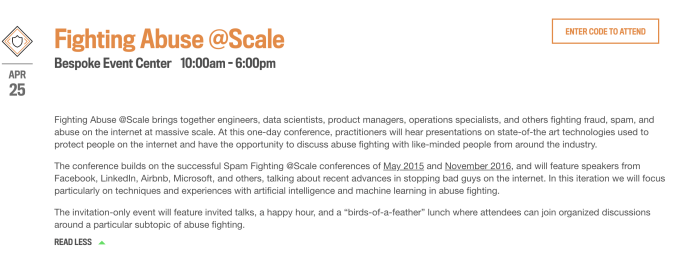
Desperate to show it takes thwarting misinformation, fraud, and spam seriously, Facebook just announced a last-minute “Fighting Abuse @Scale” conference in San Francisco on April 25th. Speakers from Facebook, Airbnb, Google, Microsoft, and LinkedIn will discuss how to stop fake news, prevent counterfeit account creation, using honeypots to disrupt adversarial infrastructure, and how machine learning can be employed to boost platform safety.

Fighting Abuse @Scale will be held at the Bespoke Event Center within the Westfield Mall in SF. We can expect more technical details about the new proactive artificial intelligence tools Facebook announced today during a conference call about its plans to protect election integrity. The first session is titled “Combating misinformation at Facebook” and will feature an engineering director and data scientists from the company.
Facebook previously held “Fighting Spam @Scale” conferences in May 2015 and November 2016 just after the Presidential election. But since then, public frustration has built up to a breaking point for the social network. Russian election interference, hoaxes reaching voters, violence on Facebook Live, the ever-present issue of cyberbullying, and now the Cambridge Analytica data privacy scandal have created a convergence of backlash. With its share price plummeting, former executives speaking out against its impact on society, and CEO Mark Zuckerberg on a media apology tour, Facebook needs to show this isn’t just a PR problem. It needs users, potential government regulators, and its own existing and potential employees to see it’s willing to step up and take responsibility for fixing its platform.


from Social – TechCrunch https://tcrn.ch/2Gkhrcu Read More Detail!

Ethx


Ethx is a secure ether wallet for India. Ethex allows users to securely purchase, monitor and sell ether in India instantaneously.

View startup


from BetaList http://bit.ly/2pLZxFy Read More Detail!

Instagram reenables GIF sharing after GIPHY promises no more racism

A racial slur GIF slipped into GIPHY’s sticker library earlier this month, prompting Instagram and Snapchat to drop their GIPHY integrations. Now Instagram is reactivating after GIPHY confirmed its reviewed its GIF library four times and will preemptively review any new GIFs it adds. Snapchat said it had nothing to share right now about whether it’s going to reactivate GIPHY.

“We’ve been in close contact with GIPHY throughout this process and we’re confident that they have put measures in place to ensure that Instagram users have a good experience” an Instagram spokesperson told TechCrunch. GIPHY told TechCrunch in a statement that “To anyone who was affected: we’re sorry. We take full responsibility for this recent event and under no circumstances does
GIPHY condone or support this kind of content . . . We have also finished a full investigation into our content moderations systems and processes and have made specific changes to our process to ensure soemthing like this does not happen again.”

We first reported Instagram was building a GIPHY integration back in January before it launched a week later, with Snapchat adding a similar feature in February. But it wasn’t long before things went wrong. First spotted by a user in the U.K. around March 8th, the GIF included a racial slur. We’ve shared a censored version of the image below, but warning, it still includes graphic content that may be offensive to some users.

When asked, Snapchat told TechCrunch ““We have removed GIPHY from our application until we can be assured that this will never happen again.” Instagram wasn’t aware that the racist GIF was available in its GIPHY integration until informed by TechCrunch, leading to a shut down of the feature within an hour. An Instagram spokesperson told TechCrunch “This type of content has no place on Instagram.” After 12 hours of silence, GIPHY responded the next morning, telling us “After investigation of the incident, this sticker was available due to a bug in our content moderation filters specifically affecting GIF stickers.”

The fiasco highlights the risks of major platforms working with third-party developers to brings outside and crowdsourced content into their apps. Snapchat historically resisted working with established developers, but recently has struck more partnerships particularly around augmented reality lenses and marketing service providers. While it’s an easy way to provide more entertainment and creative expression tools, developer integrations also force companies to rely on the quality and safety of things they don’t fully control. As Instagram and Snapchat race for users around the world, they’ll have to weigh the risks and rewards of letting developers into their gardens.

GIPHY’s full statement is below.

CHANGES TO GIPHY’S STICKER MODERATION
Before we get into the details, we wanted to take a moment and sincerely apologize for the
deeply offensive sticker discovered by a user on March 8, 2018. To anyone who was affected:
we’re sorry. We take full responsibility for this recent event and under no circumstances does
GIPHY condone or support this kind of content.
The content was immediately removed and after investigation a bug was found in our content
moderation filters affecting stickers. This bug was immediately fixed and all stickers were re-
moderated.
We have also finished a full investigation into our content moderation systems and processes
and have made specific changes to our process to ensure something like this does not happen
again.

THE CHANGES
After fixing the bug in our content moderation filters and confirming that the sticker was
successfully detected, we re-moderated our entire sticker library 4x.
We have also added another level of GIPHY moderation before each sticker is approved into
the library. This is now a permanent addition to our moderation process.
We hope this will ensure that GIPHY stickers will always be fun and safe no matter where you
see them.

THE FUTURE AND BEYOND
GIFs and Stickers are supposed to make the Internet a better, more entertaining place.
GIPHY is committed to making sure that’s always the case. As GIPHY continues to grow, we’re
going to continue looking for ways to improve our user experience. Please let us know how we
can help at: support@giphy.com.
Team Giphy.


from Social – TechCrunch https://ift.tt/2E5Cv0o Read More Detail!

Facebook starts fact checking photos/videos, blocks millions of fake accounts per day

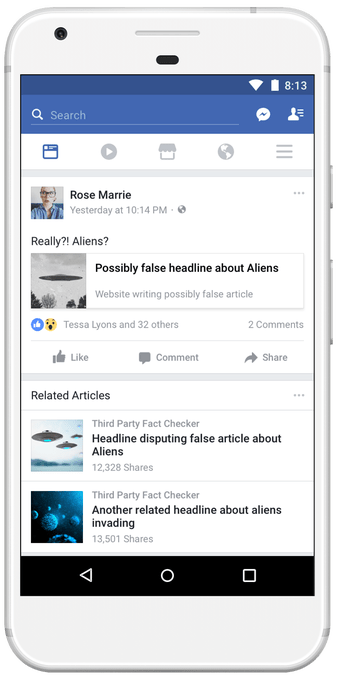
Facebook has begun letting partners fact check photos and videos beyond news articles, and proactively review stories before Facebook asks them. Facebook is also now preemptively blocking the creation of millions of fake accounts per day. Facebook revealed this news on a conference call with journalists [Update: and later a blog post] about its efforts around election integrity that included Chief Security Officer Alex Stamos who’s reportedly leaving Facebook later this year but claims he’s still committed to the company.

Articles flagged as false by Facebook’s fact checking partners have their reach reduced and display Related Articles showing perspectives from reputable news oulets below

Stamos outlined how Facebook is building ways to address fake identities, fake audiences grown illicitly or pumped up to make content appear more popular, acts of spreading false information, and false narratives that are intentionally deceptive and shape people’s views beyond the facts. “We’re trying to develop a systematic and comprehensive approach to tackle these challenges, and then to map that approach to the needs of each country or election” says Stamos.

Samidh Chakrabarti, Facebook’s product manager for civic engagement also explained that Facebook is now proactively looking for foreign-based Pages producing civic-related content inauthentically. It removes them from the platform if a manual review by the security team finds they violate terms of service.

“This proactive approach has allowed us to move more quickly and has become a really important way for us to prevent divisive or misleading memes from going viral” said Chakrabarti. Facebook first piloted this tool in the Alabama special election, but has now deployed it to protect Italian elections and will use it for the U.S. mid-term elections.

Meanwhile, advances in machine learning have allowed Facebook “to find more suspicious behaviors without assessing the content itself” to block millions of fake account creations per day “before they can do any harm”, says Chakrabarti.

Facebook implemented its first slew of election protections back in December 2016, including working with third-party fact checkers to flag articles as false. But those red flags were shown to entrench some people’s belief in false stories, leading Facebook to shift to showing Related Articles with perspectives from other reputable news outlets. As of yesterday, Facebook’s fact checking partners began reviewing suspicious photos and videos which can also spread false information. This could reduce the spread of false news image memes that live on Facebook and require no extra clicks to view, like doctored photos showing the Parkland school shooting survivor Emma González ripping up the constitution.

Normally, Facebook sends fact checkers stories that are being flagged by users and going viral. But now in countries like Italy and Mexico in anticipation of elections, Facebook has enabled fact checkers to proactively flag things because in some cases they can identify false stories that are spreading before Facebook’s own systems. “To reduce latency in advance of elections, we wanted to ensure we gave fact checkers that ability” says Facebook’s News Feed product manager Tessa Lyons.

A photo of Parkland shooting survivor Emma González ripping up a shooting range target was falsly doctored to show her ripping up the constitution. Photo fact checking could help Facebook prevent the false image from going viral. [Image via CNN]

With the mid-terms coming up quick, Facebook has to both secure its systems against election interference, as well as convince users and regulators that it’s made real progress since the 2016 presidential election where Russian meddlers ran rampant. Otherwise, Facebook risks another endless news cycle about it being a detriment to democracy that could trigger reduced user engagement and government intervention.

from Social – TechCrunch https://ift.tt/2usDecF Read More Detail!

Myki For Teams


Myki for teams is an offline password manager & authenticator for your team. Hackers shouldn't be able to compromise a publicly accessible server and as a result gain access to users credentials. Myki for Teams keep your data completely off the cloud, away from prying eyes. Myki for Teams is a decentralized solution for a universal problem.

View startup


from BetaList https://ift.tt/2GE9iiI Read More Detail!