Tuesday, 2 April 2019

,

Sigrid.AI – Introducing a smarter way to manage all your business and life admin


Sigrid.AI is a subscription-based, managed, remote executive assistant service designed for the way we work now. Staffed by highly trained executive assistants backed by a team of specialists in areas such as travel management, expense management, IT-support, and research, Sigrid.AI provides round-the-clock support for a huge array of tasks. We’re here 24/7 to take care of the details so you can take care of the big picture. Under the hood of Sigrid.AI is a machine learning platform that records your preferences, learns them, and presents them instantly to the assistant you’re working with. By learning to anticipate your needs, we learn to meet them quicker.

View startup


from BetaList - Discover tomorrow's startups, today https://ift.tt/2uHrwYZ Read More Detail!
,

Gustár – Get meal suggestions from local restaurants, catered to your tastes


Gustár is an app that gives personalized meal suggestions from local restaurants. Save time choosing where to eat, or what to order.

Start by telling Gustár what you like. Gustár will use your preferences to suggest menu items from nearby restaurants. It's like having a tailor-made menu of dishes you'll love. As you try things, tell Gustár if it was good or not, and get smarter suggestions next time. It's like Pandora for eating out!

View startup


from BetaList - Discover tomorrow's startups, today https://ift.tt/2HZ8Xbx Read More Detail!

YouTube tightens restrictions on channel of UK far right activist — but no ban

YouTube has placed new restrictions on the channel of a UK far right activist which are intended to make hate speech less easy to discover on its platform.

Restrictions on Stephen Yaxley-Lennon’s YouTube channel include removing certain of his videos from recommendations. YouTube is also taking away his ability to livestream to his now close to 390,000 YouTube channel subscribers.

Yaxley-Lennon, who goes by the name ‘Tommy Robinson’ on social media, was banned from Twitter a year ago.

Buzzfeed first reported the new restrictions. A YouTube spokesperson confirmed the shift in policy, telling us: “After consulting with third party experts, we are applying a tougher treatment to Tommy Robinson’s channel in keeping with our policies on borderline content. The content will be placed behind an interstitial, removed from recommendations, and stripped of key features including livestreaming, comments, suggested videos, and likes.”

Test searches for ‘Tommy Robinson’ on YouTube now return a series of news reports — instead of Yaxley-Lennon’s own channel, as was the case just last month.
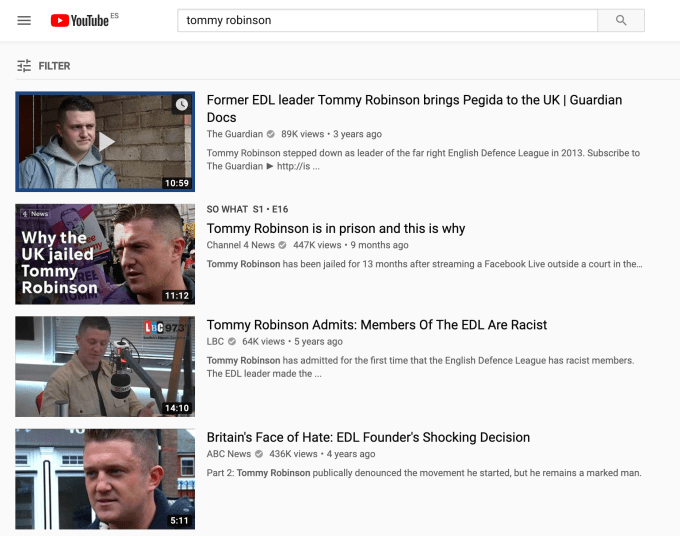
YouTube had already demonetized Yaxley-Lennon’s channel back in January for violating its ad policies.

But as we reported last month Google has been under increasing political pressure in the UK to tighten its policies over the far right activist.

The policy shift applies to videos uploaded by Yaxley-Lennon that aren’t illegal or otherwise in breach of YouTube’s community standards (as the company applies them) but which have nonetheless been flagged by users as potential violations of the platform’s policies on hate speech and violent extremism.

In such instances YouTube says it will review the videos and those not in violation of its policies but which nonetheless contain controversial religious or extremist content will be placed behind an interstitial, removed from recommendations, and stripped of key features including comments, suggested videos, and likes.

Such videos will also not be eligible for monetization.

The company says its goal with the stricter approach to Yaxley-Lennon’s content is to strike a balance between upholding free expression and a point of public and historic record, while also keeping hateful content from being spread or recommended to others.

YouTube said it carefully considered Yaxley-Lennon’s case — consulting with external experts and UK academics — before deciding it needed to take tougher treatment.

Affected videos will still remain on YouTube — albeit behind an interstitial. They also won’t be recommended, and will be stripped of the usual social features including comments, suggested videos, and likes.

Of course it remains to be seen how tightly YouTube will apply the new more restrictive policy in this case. And whether Yaxley-Lennon himself will adapt his video strategy to workaround tighter rules on that channel.

The far right is very well versed in using coded language and dog whistle tactics to communicate with its followers and spread racist messages under the mainstream radar.

Yaxley-Lennon has had a presence on multiple social media channels, adapting the content to the different platforms. Though YouTube is the last mainstream channel still available to him after Facebook kicked him off its platform in February. Albeit, he was quickly able to workaround Facebook’s ban simply by using a friend’s Facebook account to livestream himself harassing a journalist at his home late at night.

Police were called out twice in that instance. And in a vlog uploaded to YouTube after the incident Yaxley-Lennon threatened other journalists to “expect a knock at the door”.

Shortly afterwards the deputy leader of the official opposition raised his use of YouTube to livestream harassment in parliament, telling MPs then that: “Every major social media platform other than YouTube has taken down Stephen Yaxley-Lennon’s profile because of his hateful conduct.”

The secretary of state for digital, Jeremy Wright, responded by urging YouTube to “reconsider their judgement” — saying: “We all believe in freedom of speech. But we all believe too that that freedom of speech has limits. And we believe that those who seek to intimidate others, to potentially of course break the law… that is unacceptable. That is beyond the reach of the type of freedom of speech that we believe should be protected.”

YouTube claims it removes videos that violate its hate speech and violent content policies. But in previous instances involving Yaxley-Lennon it has told us that specific videos of his — including the livestreamed harassment that was raised in parliament — do not constitute a breach of its standards.

It’s now essentially admitting that those standards are too weak in instances of weaponized hate.

Yaxley-Lennon, a former member of the neo-nazi British National Party and one of the founders of the far right, Islamophobic English Defence League, has used social media to amplify his message of hate while also soliciting donations to fund individual far right ‘activism’ — under the ‘Tommy Robinson’ moniker.

The new YouTube restrictions could reduce his ability to leverage the breadth of Google’s social platform to reach a wider and more mainstream audience than he otherwise would.

Albeit, it remains trivially easy for anyone who already knows the ‘Tommy Robinson’ ‘brand’ to workaround the YouTube restrictions by using another mainstream Google-owned technology. A simple Google search for “Tommy Robinson YouTube channel” returns direct links to his channel and content at the top of search results. 

Yaxley-Lennon’s followers will also continue to be able to find and share his YouTube content by sharing direct links to it — including on mainstream social platforms.

Though the livestream ban is a significant restriction — if it’s universally applied to the channel — which will make it harder for Yaxley-Lennon to communicate instantly at a distance with followers in his emotive vlogging medium of choice.

He has used the livestreaming medium skilfully to amplify and whip up hate while presenting himself to his followers as a family man afraid for his wife and children. (For the record: Yaxley-Lennon’s criminal record includes convictions for violence, public order offences, drug possession, financial and immigration frauds, among other convictions.)

If Google is hoping to please everyone by applying a ‘third route’ of tighter restrictions for a hate speech weaponizer yet no total ban it will likely just end up pleasing no one and taking flak from both sides.

The company does point out it removes channels of proscribed groups and any individuals formally linked to such groups. And in this case the related far right groups have not been proscribed by the UK government. So the UK government could certainly do much more to check the rise of domestic far right hate.

But YouTube could also step up and take a leadership position by setting robust policies against individuals who seek to weaponize hate.

Instead it continues to fiddle around the edges — trying to fudge the issue by claiming it’s about ‘balancing’ speech and community safety.

In truth hate speech suppresses the speech of those it targets with harassment. So if social networks really want to maximize free speech across their communities they have to be prepared to weed out bad actors who would shrink the speech of minorities by weaponizing hate against them.


from Social – TechCrunch https://ift.tt/2TQ67H9 Read More Detail!
,

Snippect – In-page Conversational Marketing Platform For Increased Lead Conversion


Snippect is a better way to engage your visitors & convert them into paying customers.

Say goodbye to annoying popups with Snippect's contextual conversations that deliver higher engagement and more conversions. - Collect lead information from any landing page - Guide visitors to relevant pages even as you convert them into leads - Engage and convert blog readers

View startup


from BetaList - Discover tomorrow's startups, today https://ift.tt/2JYE5cV Read More Detail!

Monday, 1 April 2019

,

Gitstore – Sell access to your code


Gitstore is a tool allowing you to build a paying subscriber or donor base for your Private Repositories and Open Source projects.

It supports once-off payments and recurring subscriptions so that the people who use your code have many ways to support the ongoing efforts to maintain it.

View startup


from BetaList - Discover tomorrow's startups, today https://ift.tt/2CLtR9C Read More Detail!

Facebook asks for public input about its plans for a content oversight board

In November, Facebook announced its plans to create an external content oversight board that would serve as something of a “supreme court” for Facebook’s more controversial content policy decisions. The company took the first steps in January to describe how this content review board would function with the release of a draft charter. Today, Facebook is opening up a public consultation process to help it answer more questions around the Oversight Board’s design.

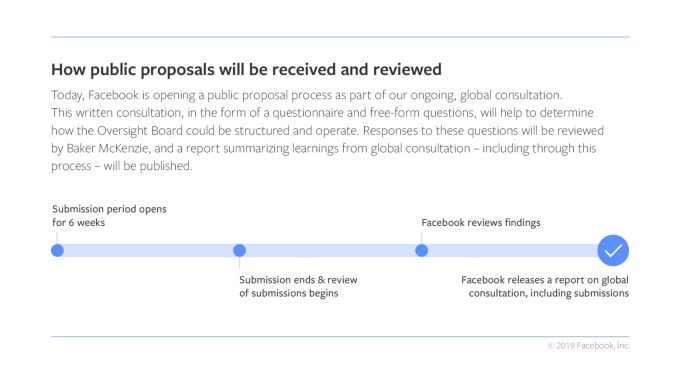
Over the next six weeks, Facebook says it will accept submissions from the public about its plans.

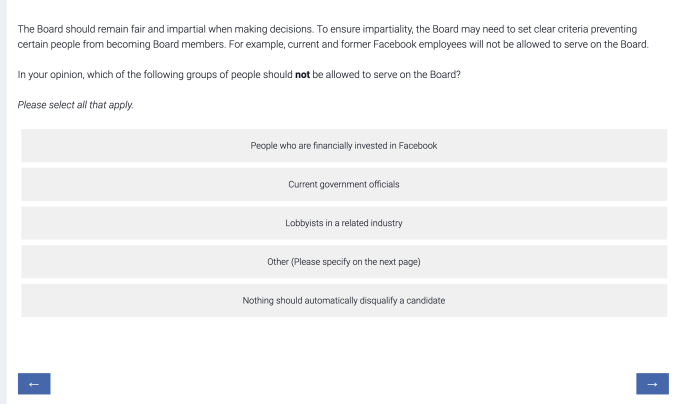
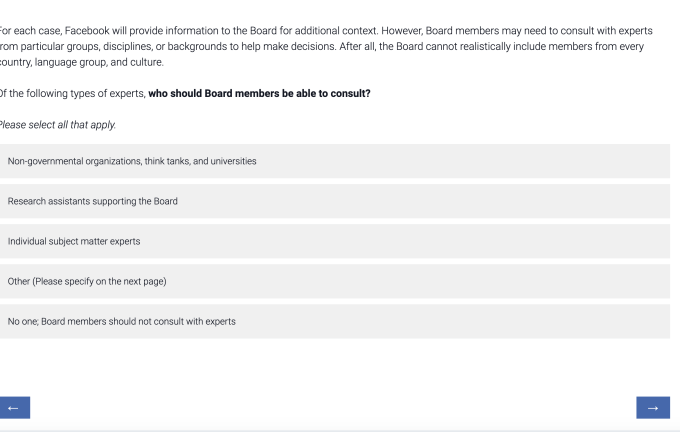
Public submissions will include two parts: a questionnaire and free-form questions.

The latter will focus on gathering input around membership, case decisions and governance. The questionnaire portion, however, is a more straightforward user survey where participants are asked to vote on various aspects (many already detailed in the draft charter) – like how many total members should the board have, how long they should serve, how they should gain their positions, what their makeup should be in terms of background, professional experience, views and diversity, among other things.

It also asks the public to weigh in on how the Oversight Board will make decisions on cases, with questions about how their rulings will impact policy, what subject matter experts they can consult, whether they should review written opinions from those the case affects, the precedent set by prior rulings, and more.

Some of these questions are simpler to answer, while others may give survey respondents pause.

For example, one asks if it’s more important for the board to dedicate more time and research to each case or if it should prioritize making more decisions each year?

While obviously all cases reviewed should be well-researched, if you believe Facebook’s board should resemble the U.S. courts system, then there should be guidance around how long its board members have to make a decision. Otherwise, it could see some of the toughest content policy decisions tied up in never-ending deliberations, with the board citing “more research is needed” to rule. That wouldn’t be fair to those whose content is held hostage in the meantime. But the question doesn’t allow for this level of nuance – so you’d need to take to the essay portion to share this position.

However, anyone can take the survey portion of the questionnaire and can choose to skip the essay section if they don’t have more to add.

Facebook says it has partnered with the firm Baker McKenzie, which will help it review the submissions. The responses will be summarized in a report published in June.

For Facebook, the launch of an independent review board allows the company to further distance itself from controversial policy decisions.

As we noted in January, decision-making around content removals is an area where Facebook has repeatedly and publicly failed, and with disastrous consequences. The company has been widely criticized for how it handled issues like the calls to violence that led to genocide in Myanmar and riots in Sri Lanka; election meddling from state-backed actors from Russia, Iran and elsewhere; its failure to remove child abuse posts in India; the weaponization of Facebook by the government in the Philippines to silence its critics; Facebook’s approach to handling Holocaust denials or conspiracy theorists like Alex Jones; and more.

The board’s creation will not only take the pressure off Facebook to make these decisions, it’s also an admission of sorts that Facebook agrees it’s not able to handle this level of responsibility any longer.

Those interested in sharing their own thoughts around the review board can go here for the survey.


from Social – TechCrunch https://ift.tt/2FQNtva Read More Detail!

New Facebook tool answers the question ‘Why am I seeing this post?’

Facebook announced today that it is adding to News Feeds a feature called “Why am I seeing this post?” Similar to “Why am I seeing this ad?,” which has appeared next to advertisements since 2014, the new tool has a drop-down menu that gives users information about why that post appeared in their News Feed, along with links to personalization controls.

Meant to give users more transparency into how Facebook’s News Feed algorithm works, the update comes as the company copes with several major events that have highlighted the platform’s shortcomings, including potentially harmful ones. These include its role in enabling the dissemination of a video taken during the shooting attacks on New Zealand mosques two weeks ago, which were originally broadcast using Facebook Live; a lawsuit filed by the U.S. Department of Housing and Urban Development that accuses Facebook’s ad-targeting tool of violating the Fair Housing Act and its role in spreading misinformation and propaganda (after years of complaints and criticism, Facebook recently announced plans to downrank anti-vaccination posts and ban white nationalist content.

Facebook’s announcement says this is the first time it has “built information on how ranking works directly into the app.” Users will be able to access “Why am I seeing this post?” as a drop-down menu in the right-hand corner of posts from friends, Pages and Groups in their News Feed, which displays information about how its algorithm decided to rank the post, including:

  • Why you’re seeing a certain post in your News Feed — for example, if the post is from a friend you made, a Group you joined or a Page you followed.
  • What information generally has the largest influence over the order of posts, including: (a) how often you interact with posts from people, Pages or Groups; (b) how often you interact with a specific type of post, for example, videos, photos or links; and (c) the popularity of the posts shared by the people, Pages and Groups you follow.

The same menu will also include links to personalization options, including See First, Unfollow, News Feed Preferences and Privacy Shortcuts. The company’s blog post said that “during our research on ‘Why am I seeing this post?,’ people told us that transparency into News Feed algorithms wasn’t enough without corresponding controls.”

“Why am I seeing this ad,” a similar feature that launched in 2014, will be updated with to include more information. For example, it will tell users if an ad appeared in their News Feed because a company uploaded their contact lists, like emails or phone numbers, or if they worked with a marketing partner to place the ad.


from Social – TechCrunch https://ift.tt/2WAtaY7 Read More Detail!
,

PHPLogger – Collection PHP Application logs and make use of them


PHPLogger is a solution for log collection and analysis for a PHP application. It's early stages, but we are able to collect logs and provide access to them already. The final goal of the project is to provide ability of building application metrics on logs, and later integrate that with leading CMS / Frameworks.

View startup


from BetaList - Discover tomorrow's startups, today https://ift.tt/2OCXcaZ Read More Detail!

German LinkedIn rival Xing is rebranding as ‘New Work’ acquires recruitment platform Honeypot for up to $64M

Xing, the business networking platform that has been described as Germany’s answer to LinkedIn, has made an acquisition to beef up its recruitment business ahead of a rebrand of the business as “New Work.” The company has acquired Honeypot, a German startup that has built a job-hunting platform for tech people, for up to €57 million ($64 million). Xing tells us that Honeypot is its biggest acquisition to date.

The figure includes the acquisition (€22 million) plus a potential earn-out of up to €35 million if certain targets are met in the next three years.

Xing said that it plans to rebrand as New Work in the second half of 2019, bringing together a number of other assets it has acquired and built over the years.

“This acquisition is an excellent addition to our New Work portfolio,” Thomas Vollmoeller, CEO at Xing, said in a statement. “Honeypot focuses on candidates by helping them to find a job matching their individual preferences… With subsidiaries and brands such as kununu and HalloFreelancer, Xing is far more than just a single network. New Work is the umbrella spanning all our business activities.” Xing said that all the smaller companies will keep their branding.

Xing already offered job listings as part of its platform, with 20,000 businesses as customers; but Honeypot will add a few different things to the mix.

First, it will give Xing more traction specifically in the tech vertical, since Honeypot first started out in 2015 targeting developers although it later expanded to other tech jobs.

Second, Honeypot’s structure is a natural fit for a social recuitment platform: as with a lot of social recruiting, Honeypot lets recruiters use platforms, profile pages and social graphics to find and approach candidates, rather than candidates reaching out in response to specific opportunities.

Honeypot adds additional features to help make this process more accurate and less of a waste of time on both sides. Those doing the recruiting have to provide specific details around salary and, say, programming languages required, as part of their outreach. On the other side, individuals go through a “brief expertise check” to vet them, and they too have to be a bit more specific on what they can and what they want to do, and what they want to earn, to help weed out opportunities that might not be suitable.

Third, the acquisition will help Xing make a bigger push into building its profile outside of Germany into more of Europe, as New Work.

This is no small thing. Xing years ago was considered a would-be rival to LinkedIn. But — and this was perhaps even more true in the past, and Xing was founded in 2003 — scaling startups to be global players out of Europe can be a challenge, even more so when there is a formidable direct competitor growing quickly as well.

In the end, Xing developed as a much more modest operation, relatively speaking. While LinkedIn today has some 600 million users and was acquired by Microsoft in 2016 for $26.2 billion, Xing is publicly traded and currently valued at around $2 billion (€1.81 billion), with some 15 million members.

Xing says that today Honeypot’s current emphasis is German-speaking countries and the Netherlands, which together cover some of the biggest startup hubs in Europe, including Berlin and Amsterdam.

The company is still relatively small but growing, adding 1,000 IT specialists to its books each week, with some 100,000 individuals and 1,500 businesses currently registered. Xing said that it will be investing in the company to expand to more markets in Europe, as well as to grow its business by tapping Xing’s own customer base.

Although there have been some notable exceptions like payments startup Adyen from the Netherlands, Farfetch from the UK and Spotify (originally from Stockholm, grown in London and now increasingly a US company), scaling startups in Europe has proven to be challenging.

One of the big reasons why has to do with a shortage of talent to build these companies: in Germany alone — home to the buzzy startup city of Berlin — there are 82,000 unfilled tech jobs. In other words, there is an opportunity for more user-friendly platforms to help connect those dots.

XING and Honeypot both have the vision of helping people to further their career. We want Honeypot to offer the world’s largest work-life community for IT specialists by giving candidates the power to decide on their next career step,” said Kaya Taner, CEO who founded Honeypot with Emma Tracey. “We will continue to pursue this vision with XING. Going forward, around 100,000 IT specialists from all over the world who are registered on Honeypot will be able to connect with the many first-rate employers in German-speaking countries. This will enable Honeypot to continue developing its domestic market, while also further expanding its international community.”


from Social – TechCrunch https://ift.tt/2UpfORd Read More Detail!
,

Eddii – Meet Eddii, your new virtual health buddy


Eddii is a virtual in-app character designed to engage people living with chronic conditions to track and record their health. Through gamification and witty conversation, Eddii becomes a smart, virtual health buddy, providing users with weekly health reports and collectible in-app items in return for data entry.

Our mission is to motivate all those taking medication to record their wellness daily and adhere to healthy routines, leading to better outcomes!

View startup


from BetaList - Discover tomorrow's startups, today https://ift.tt/2TSV7Je Read More Detail!
,

Pillintrip – Drug equivalents search service for travelers and expats


Pillintrip is a search engine with own database that helps to find equivalents and analogues of drugs in 127 countries of the world. Indispensable for travelers and expats. A database of 180,000 drugs was collected using technology-based data collection solutions and tested by pharmacists. Unique on the web. Using for free, no registration needed.

View startup


from BetaList - Discover tomorrow's startups, today https://ift.tt/2YI0nmC Read More Detail!