Saturday, 5 January 2019

,

Mastering ADHD – Modern, empirically-proven tools to help individuals & families manage ADHD


Mastering ADHD is an iOS app that leverages tools based on modern, empirically-proven treatment strategies in cognitive behavioral therapy (CBT) to help individuals and families conquer the symptoms of ADHD.

With Mastering ADHD, you'll be able to better keep your appointments, finish tasks, overcome distractions, and end procrastination – and parents will be able to help their children do the same while building powerfully good habits to manage their ADHD throughout life.

View startup


from BetaList - Discover tomorrow's startups, today http://bit.ly/2GYyfGS Read More Detail!

Friday, 4 January 2019

,

AutoDS – Automated All in One Dropshipping tool


AutoDS is dropshipping automation magic. AutoDS, helps thousands of clients to live a worry-free life while we run their eBay e-commerce business. AutoDS will help you upload a new listing, monitor price and stock change, automatically order and update tracking and everything you need to run your e-commerce business.

View startup


from BetaList - Discover tomorrow's startups, today http://bit.ly/2BXBh8o Read More Detail!

TikTok’s quietly launched ‘Lite’ app has reached over 12 million downloads since August

Short-form video app TikTok has been growing in popularity across international markets, including in the U.S. where a merger with Musical.ly has seen the app topping the App Store charts. Facebook and Snapchat have been hastily trying to copy TikTok’s features as a result. A part of TikTok’s ambitious global expansion plan has been its more recent targeting of emerging markets – like India and Indonesia – where the company’s quietly launched “TikTok Lite” app has been gaining ground in the latter half of 2018.

TikTok hasn’t yet made much fuss over its Lite version, which actually consists of two separate apps.

The first was launched on August 6, 2018 in Thailand, but is now available across other primarily Asian markets, including Indonesia where it’s most popular, as well as Vietnam, Malaysia, and the Philippines.

This version of TikTok Lite has grown to 5 million installs since its August debut. (It’s actually written with a lowercase “l” in “Lite” in the Play store, which is how you can tell the difference between this and the other app.)

This version was also briefly live in India, Brazil, and Russia, but now these countries are served by a separate Lite app (written as “Lite” with an uppercase “L”), which launched on November 1, 2018.

This second version of TikTok Lite has now become the larger of the two, thanks to India. It has around 7.1 million total downloads, according to Sensor Tower data.

It has also now been installed across 15 additional non-Asian countries, including Egypt, Brazil, Algeria, Tunisia, Russia, Ecuador, South Africa, Dominican Republic, Guatemala, Kenya, Costa Rica, El Salvador, Nigeria, Angola, and Ghana.

Combined, the two TikTok Lite apps have gained over 12 million downloads in around six months’ time, TechCrunch confirmed with Sensor Tower.

However, TikTok Lite is not being heavily promoted at this time – especially when compared with the outsize marketing that TikTok’s flagship app has been seeing as of late.

This advertising is courtesy of TikTok’s Chinese parent company, ByteDance, which has had an infusion of billions in outside capital recently. The company is valued at $78 billion, as of October.

And it’s spending, apparently:

E.g.:

Sensor Tower found that more than half of TikTok Lite’s downloads came over the past month, following TikTok Lite’s return to India. Combined, the two Lite apps’ downloads reached around 6.7 million in December, which was a 158 percent increase over November’s 2.6 million installs, it said.

Despite TikTok Lite’s growth, 12 million+ downloads is only a drop in the bucket when it comes to TikTok’s larger user base. This represents only 4.5 percent of TikTok’s downloads on Google Play since August 2018, and only about 3.6 percent of all TikTok downloads since then across both the iOS and Google Play app stores combined.

To date, TikTok’s main app has been downloaded over 887 million times on Google Play. That doesn’t count the downloads from the Chinese version called Douyin, which is found on third-party Android app stores. That means TikTok’s true install base is even bigger.

ByteDance itself had publicly said last July the TikTok user base had grown to 500 million+ monthly active users – a way of counting who’s regularly using the app, instead of just installing it on their phone.
Given that Facebook Lite grew to 200 million users in under two years‘ time, it seems like a “Lite” version of TikTok, now one of the world’s biggest apps, could be doing a bit better than 12 million installs over a six month period.

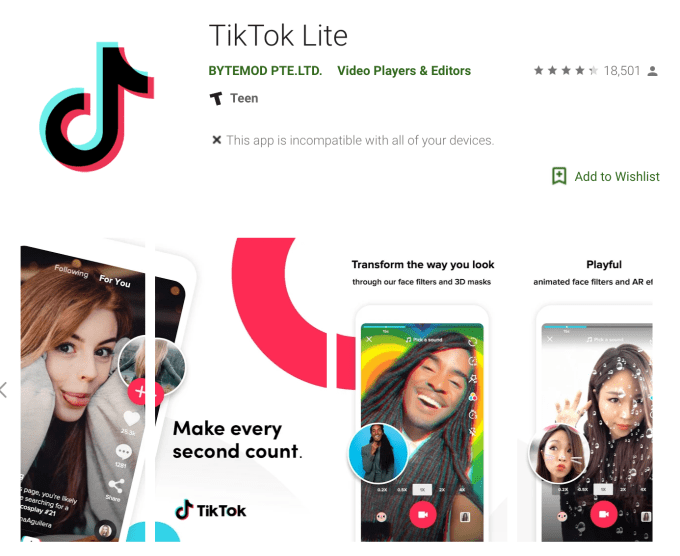
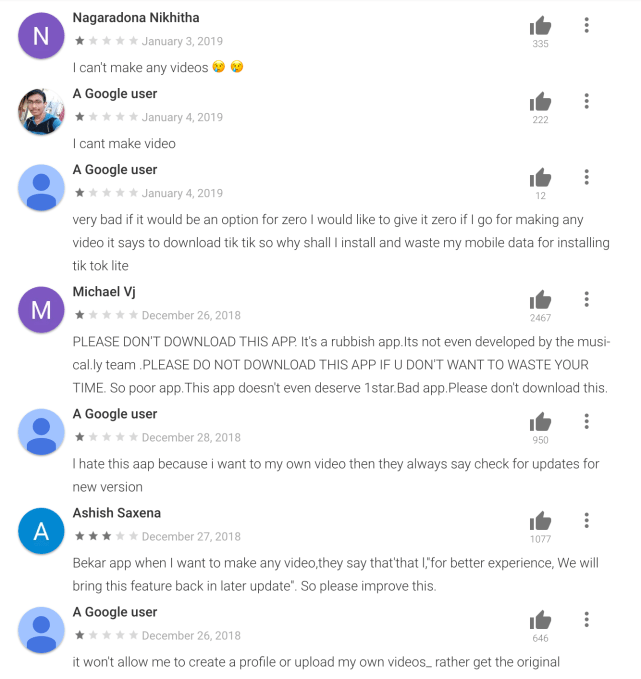
The problem seems to stem from a variety of factors, including how TikTok Lite is marketed in the Play Store. The app uses screenshots and a description that make it seem like it’s just another version of TikTok. But according to user reviews, people were disappointed to find it’s a consumption-only app. Many have left reviews complaining about how they can’t make videos. They call it “fake” and “bad” as a result.

TikTok would do better to clarify how its Lite version is different, to eliminate this confusion.
It’s common for major tech companies to offer a “lighter” version of their app for emerging markets where low bandwidth is a concern. These apps tend to be smaller in size, more performant, and sometimes either have reduced capabilities or special features aimed at low-bandwidth users.

Google, for example, has a suite of light apps – the “Go” edition apps – like Gmail Go, YouTube Go, Files Go, Google Go, Google Maps Go, and Google Assistant Go. Uber now offers Uber Lite. Facebook operates apps like Facebook Lite, Messenger Lite, and Instagram Lite – the latter which launched just ahead of TikTok Lite, in fact.

Like most “Lite” apps, TikTok Lite clocks in at a smaller size – it’s only 10MB to 11MB (depending on the version) versus the much larger 71MB of TikTok’s main app.

A rep for TikTok confirmed the company is now offering a Lite version in some markets so users can choose a smaller app if they have concerns around data or the storage space on their phone. No other information about the Lite versions or strategy was provided.

So far, ByteDance’s efforts around TikTok Lite seem more experimental, given it hasn’t put up a proper description on Google Play; runs two separate Lite versions; and had offered the app in some markets briefly, pulled out, then returned with another version. It will be interesting to see what TikTok Lite becomes when it gets the sort of attention that the main TikTok app is receiving today.


from Social – TechCrunch https://tcrn.ch/2VuOw9C Read More Detail!
,

Secertr – Scans your git commits and alerts you if secret keys are compromised


Secretr is a cyber-security start-up which integrates directly with GitHub to help protect and secure our user's secrets.

We scan your git commits for compromised secrets. We report our findings using GitHub Checks to give you feedback directly integrated your code. Secretr uses a variety of techniques to detect secrets; which we are continuously improving.

View startup


from BetaList - Discover tomorrow's startups, today http://bit.ly/2BWfyxC Read More Detail!
,

Mindot – Maintain your daily mindfulness routine


Mindot is a small desktop app that helps you maintain your daily mindfulness routine, it's focused on people spending a lot of time in front of computers and loosing a track of the time. All it takes is to compose your background sounds to get rid of sound distractions, set your timer, and start session.

View startup


from BetaList - Discover tomorrow's startups, today http://bit.ly/2BYvobl Read More Detail!
,

eaterpad – Better understand the foods you eat


eaterpad is an app that will help you better understand your eating habits. We aim to provide you with as much nutrient data as possible as well as customized tooling so you can make informed decisions on what to eat. It only uses high quality nutrition data and is completely free to use.

View startup


from BetaList - Discover tomorrow's startups, today http://bit.ly/2QkapVz Read More Detail!

Thursday, 3 January 2019

,

EntrĂ©e – Tools to help develop and validate your idea easily and in the right way


EntrĂ©e is an all-in-one, collaborative workspace for aspiring and seasoned entrepreneurs. Using the lean startup methodology, EntrĂ©e requires entrepreneurs to take a problem-first approach to understand their customers and iterate their solution, creating a product or service that their customers truly need — and are willing to buy.

On our online platform, you will find strategic management tools (BMC, VPC, SWOT, etc) to get you started on building the next big thing. In a structured way, you will better understand your customers’ biggest problems as you develop and test your ideas (and MVP) in the real world. We want to help by making starting up easier and done in the right way.

View startup


from BetaList - Discover tomorrow's startups, today http://bit.ly/2F8E8yG Read More Detail!

PR management firm Cision is acquiring Falcon.io to expand into social media marketing

Social media has become a primary conduit for getting the word out, in some cases proving to be an even stronger force for publicity than more traditional media outlets and paid advertising, and so today, a company that has grown its business around public relations services has acquired a social media management company to make sure it has a foothold in the medium. Cision, which provides press release distribution, media monitoring, and other PR services to businesses and the media industry, has acquired Falcon.io, a startup founded in Denmark that lets companies post, manage and analyse their presence on social media platforms.

Terms of the deal are not being disclosed, the companies tell me, but the whole of the Falcon team, including CEO/founder Ulrik Bo Larsen, are joining the company, where they will continue to operate its existing product set as well as integrate it into Cision’s wider business. The last valuation noted in April 2017 at the Danish Companies House was about $52 million (€45 million) but they have been growing very rapidly, and one source tells us that the price paid was around $200-$225 million, while Danish publication Borsen says it’s 800 million Danish kroner, or around $122 million. I’m still trying to get more detail.

Falcon had raised around $25 million according to PitchBook, and it has never disclosed its valuation. Cision — well known to many journalists — is publicly traded and currently has a market cap of just under $1.6 billion. For some context, two other prominent social media management firms that compete with Falcon, Sprout Social and Hootsuite, are respectively valued at $800 million and anywhere between $750 million and $1 billion (depending on who you ask).

The latter two are bigger firms — Falcon has around 1,500 businesses as customers who use it to manage their social profiles and read social sentiment across platforms like Facebook, Twitter, and LinkedIn, while Sprout says it has around 25,000 and Hootsuite counts millions of individual users — and both have raised significantly more capital, but their valuations underscore the demand that we’re seeing for platforms and user-friendly tools to target the world’s social media users — estimated to number at upwards of 2.5 billion people globally.

Kevin Akeroyd, who came on as Cision’s CEO after long stints at both Oracle and Salesforce among other places, describes Falcon as a “top five” social media marketing and analytics firm, and in an interview he said that the new acquisition will form a key part of the “communications cloud” that Cision has been building.

As with Salesforce, Oracle and Adobe (who also use similar cloud-themed terminology to describe their product suites), Cision’s strategy is to build a one-stop shop for customers to manage all of their communications needs from one platform. Falcon itself may be smaller than its competitors, but idea is that it will be cross-sold to Cision’s customers, which currently number 75,000 businesses.

“We’re seeing too many of our customers using one application for content, another for something else, and so on. There are too many apps,” he said. “We have always believed in earned media” — that is, media mentions that are not in the form of paid advertising — “and the role of influencers alongside paid and owned marketing. We believe we could provide the first solution for businesses across earned, communications services and public relations, helping to build a better data stack to measure and attribute what you are doing in comms.”

As social networking companies like Facebook and Twitter build more of their own tools in-house to serve the social media needs of organizations who want to better manage their profiles and interactions on these platforms, this has led to some consolidation and shifts among social media management companies. Some are merging or getting acquired, and some are shopping themselves around.

And in that wider trend, it’s not too surprising to see public relations firms get in on the action. Social media has completely changed the landscape for how information is disseminated today, sometimes complementing what traditional media organizations do — there are many examples of how newspapers and other news outlets leverage, for example, Facebook to grow and communicate with their audiences — and often replacing traditional media altogether. (Pew last month said that social media outpaced newspapers for the first time as a news source in the US, although TV and radio are still bigger than social… for now.)

Given that public relations management has long been the connecting link between organisations and media outlets, they have had to take a bigger step into social media in order to provide a more complete picture of the media landscape to their clients. Cision is not the first to have done this: Last year, Meltwater, another media monitoring firm, acquired DataSift to add social signals and traffic to its platform mix.

“This consolidation has to come because there is just too much value for the user,” Akeroyd said. “CMOs and CCOs do not want their own islands, they want something bigger.”


from Social – TechCrunch https://tcrn.ch/2GQ15Jh Read More Detail!

Workplace, Facebook’s enterprise platform, adds another major customer, Nestle

While Facebook continues to repair its image with consumers disenchanted with the social network’s role in disseminating misleading or false information and mishandling their personal data, it’s ironically been finding some traction for its enterprise-focused service, Workplace. Today, the company announced that it has added another huge company to its books today: Nestle, the coffee, chocolate and FMCG giant with 2,000 brands and 240,000 employees, has signed up as its latest customer.

Facebook’s enterprise service competes against the likes of Microsoft Teams, Slack and smaller players like Crew and Zinc, among many others in a crowded market of mobile and desktop apps built to address a growing interest among organizations to have more user-friendly, modern ways for their employees to communicate.

Workplace positions itself as different from its competitors in a couple of different ways: it says its communications platform is designed for all different employment demographics, covering so-called knowledge workers (the traditional IT customer) as well as waged and front-line employees; but it also claims to be the most democratic of the pack, by virtue of being a Facebook product, designed for mass market use from the ground up.

In the workplace, that translates to apps that do not require company email addresses or company devices to use; a strong proportion of employees at Workplace’s bigger customers, such as Walmart (2.2 million employees) and Starbucks (nearly 240,000 employees) do not sit at desks and, until relatively recently, would not have been using any kind of PC or phone on a regular basis on any average day.

But as smartphones have become as ubiquitous as having your keys and wallet, acceptance of having them and utilising them to communicate workplace-related information has changed, and that is the wave that services like Workplace are hoping to ride.

But despite the strong engine that is Facebook behind it, Workplace has a lot of challenges up ahead.

The company has not updated its total number of customers in over a year at this point — its last milestone was 30,000 customers, back in November 2017 — and today Facebook VP Julien Codorniou said that the company might put out a more updated number later this year.

“We’re not using that metric to communicate our success,” he said, “but we have to communicate growth, I feel the demand from the market.” Slack claims 500,000 organizations, over 70,000 of which pay; Teams from Microsoft has some 329,000 customers, the company says.

There is also the issue of how a customer win is actually translating to usage. Last month, a much smaller competitor, Crew, with 25,000 customers, noted that at least some of them were in fact those that Workplace was claiming to have secured.

“Starbucks is theoretically using Workplace, but it’s been deployed only to managers,” Crew CEO Danny Leffel told me. “We have almost 1,000 Starbucks locations using Crew. We knew we had a huge presence there, and we were worried when Facebook won them, but we haven’t seen even a dent in our business so far.”

Codorniou said that this also doesn’t tell the full story. He describes the approach that Crew and others take as “shadow IT” in that the companies don’t talk to central HQ when winning the business. “You can’t give a voice to everyone by going in through the back,” he said. He also contends that it just takes time to deploy something across a massive business. “Workplace only works if you get 100 percent of the company using it,” he added. Notably, today Facebook announced that Nestle has already onboarded 210,000 customers to Workplace.

There is also the bigger question of how these products will develop technically to further differentiate from the pack. For now, it feels like Slack still reigns supreme when it comes to desktop knowledge worker functionality — even without usefully threaded comments — because of the fact that you can integrate virtually any other app you might want to into its platform.

Crew, meanwhile, has differentiated by focusing on providing handy tools to help businesses managing scheduling for shift workers, who comprise the majority of its user base.

While others like Teams, and yes, Workplace, have also added in integrations and their own functionality — Workplace’s most interesting features, I think, are how it has translated consumer-Facebook features like Live into the Workplace environment. But there is still a lot of space for apps to consider what other features and functionality will be most useful and stick for the most employees and for the business customer at large.

It will be interesting to see how and if this is affected by way of a key leadership appointment. Last month, Facebook appointed a new “head” of Workplace, Karandeep Anand, who came to Facebook three years ago from Microsoft (and thus has a close understanding of enterprise software). Codorniou said Anand be relocating to London, where Workplace is developed, and will focus on the technical development of the product while Codorniou focuses on sales, client relations and business development.

Technical leadership for Workplace had previously come straight from CTO Mike Schroepfer, Codorniou said. “We decided that we needed someone full time, here in London,” he said.

It’s not clear if Workplace’s win at Nestle is replacing another product: it seems, however, that it is more likely a trend of how more businesses are making an investment in company-wide communications platforms where they may never have had one before, in hopes of it helping keep employees switched on, linked up, and generally more happy and feeling less like expendable cogs.

“NestlĂ© is a people-first environment,” said EVP Chris Johnson, in a statement. “We really rely on our talented teams to manage more than 2,000 NestlĂ© brands worldwide. We help our employees develop and we give them the right tools, so Workplace is a perfect fit.”


from Social – TechCrunch https://tcrn.ch/2Vrg13V Read More Detail!
,

Snipper App – Save your code snippets and notes


Snipper App - a native snippets manager, built with Swift4 for MacOS exclusively, aiming to be a single tool for saving your day to day working notes, snippets of code, and just a good helper in the developer's life.

*** Main Features *** * editor with the syntax highlighting * multiple programming languages are supported * different storage types * light and dark themes are included *** Storages *** Snipper designed in a way to support multiple storages, and the supported storage types will be extended in the next versions. The v1 provides two storage types: * Local storage * iCloud storage Any feedback is highly appreciated : )

View startup


from BetaList - Discover tomorrow's startups, today http://bit.ly/2F5gJ1J Read More Detail!
,

MEDIAR – Community-driven digital space empowering fans and enabling dApps building


MEDIAR develops a global ecosystem which empowers fans, improving their position within the industry & provides the framework that allows creation, management and profiting from fan community-based ventures and apps. The set of unique MEDIAR characteristics: 1. Fans-driven decentralised community. Sport lovers will obtain advanced position and will be rewarded just for being fans. 2. Innovative win-win business model. By joining the ecosystem and bringing special offers for fans, partners automatically obtain large product-oriented groups for marketing. 3. Engine to launch decentralised applications. MEDIAR is not only a virtual network or a single app but the advanced software lab.

View startup


from BetaList - Discover tomorrow's startups, today http://bit.ly/2GT3xyU Read More Detail!