Thursday, 1 November 2018

,

GetReferrals – Referral program that works 🚀 with Share and Earn buttons 🤩


GetReferrals is a new tool for online stores from BitRewards. The solution allows an easy set up a referral program that works for any online store. Researching current solutions at popular stores allows us to develop ready-made scenarios for embedding the referral program on virtually any site.

View startup


from BetaList - Discover tomorrow's startups, today https://ift.tt/2OhIvIx Read More Detail!
,

Emojics for Emails – Collect feedback via newsletter, support and sales email


Emojics for Emails, add our free widget to your emails or newsletters and start collecting feedback and suggestions from your users. Let your contacts what they think about your messages, thanks to our emoji widget.

View startup


from BetaList - Discover tomorrow's startups, today https://ift.tt/2QcuLk9 Read More Detail!
,

Unreplied – Know who hasn't replied to your emails


Unreplied is an automatic Gmail label for emails you're awaiting a reply to.

We all send a ton of important email, but there's no way to know who still needs to get back to you. With Unreplied you have full insight into who you should follow up with.

View startup


from BetaList - Discover tomorrow's startups, today https://ift.tt/2Jx9nUc Read More Detail!

Instagram’s next cash cow: instant Promote ads for Stories

Instagram hopes dollars from long-tail of small businesses and social media stars can help it pull its weight in the Facebook family. A new ad type called “Promote” for Stories allows Instagram business pages to show their ephemeral slideshows to more users without doing much work. Admins can choose to auto-target users similar to their followers, people in a certain location, or use all of Instagram’s targeting parameters to inject their Story into the Stories queue of more users as an ad that can also link to business’ Instagram profile or website.

Facebook confirms to TechCrunch that Promote for Stories works similarly to Facebook’s Boost option that lets them pay to instantly show their feed posts to more users. “I can confirm that we are testing this feature globally. We don’t have an immediate timeline for 100% rollout, but will keep you posted” an Instagram spokesperson told me. Screenshots of Promote were first shared by social consultant Matt Navarra.

Instagram tests new Promote Stories ads. Image Credit: Matt Navarra

Instagram already has 2 million active advertisers, compared to Facebook’s 6 million. But designing and targeting ads, especially full-screen video Stories ads can be daunting to small businesses and public figures. Promote offers an easy way to turn their existing Stories into ads.

The feature could unlock more spend at crucial time when Facebook’s revenue growth is in massive decline. It dropped from 59 percent year-over-years revenue growth in Q3 2016 to 49 percent in Q3 2017 to 33 percent in Q3 2018 as it hits saturation in lucrative developed countries and runs out of News Feed space. Facebook warned Wall Street about revenue deceleration as sharing shifts from feeds to Stories and advertisers have to adapt, but turning local merchants and influencers into paying customers could smooth that transition.

Instagram Analytics Launches In Beta

In other Instagram business news, today it launched Instagram Analytics in beta as part of Facebook Analytics. The tool goes beyond Instagram’s existing Insights tool that just counted different types of engagement with an account and its content, such as new followers, website clicks, post impressions, and Story exits. With Instagram Analytics, business accounts can track life time value and retention rates for people who do or don’t interact with their content, and create audience segments to see if people who commented on a particular post generate more value for them. They can also analyze how their Instagram audeince overlaps with people who visit their site, download their app, or Like their Facebook Page.

The more Instagram analytics businesses have access to, the better they’ll be able to prove that their investment in the platform is paying off. Being able to see exactly how followers move through a conversion funnel will result in higher confidence in campaigns and translate into more ad and content spend.

IGTV Hopes For Virality With Stories Previews

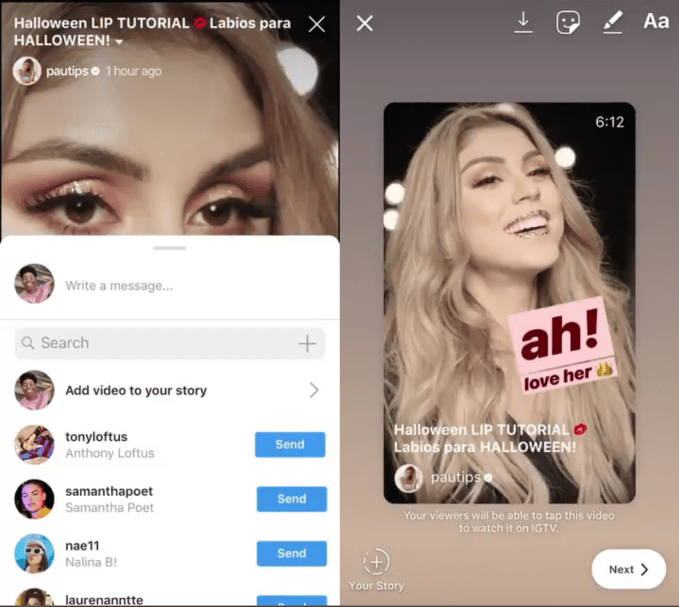
And there’s one final piece of Instagram news for the day. IGTV hasn’t quite blown up like Instagram Stories since launching in June, but a combination could bring some much needed attention to the app’s longer form video hub. Instagram today launched the ability to share preview image of an IGTV video to your Instagram Story. Friends can tap through to actually watch the full video on IGTV.

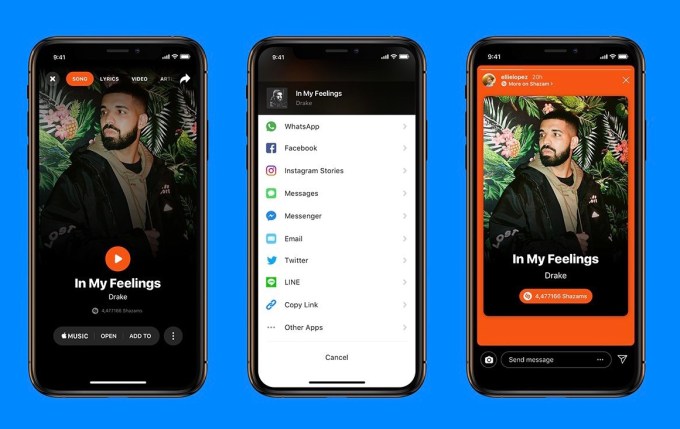
The IGTV previews don’t actually play, they’re just a static sticker. Shazam launched its own Instagram Stories integration today works similarly to the IGTV previews as well as SoundCloud and Pandora’s partnerships. Shazam lets you share a preview image of a song to your Instagram Story, but to actually hear any music you have to click through to Shazam. That makes these integrations inferior to Instagram’s own native music sharing feature that actually lets you add a soundtrack to your Stories that friends can hear as they watch.

Shazam now can share song preview images to Instagram Stories, but you have to tap through to hear anything

IGTV has also recently added a History tab that shows what you’ve recently watched. This could be helpful for getting back to your favorite clips or jumping to a new episode of a show you’re hooked on.

Facebook CEO Mark Zuckerberg said on Tuesday’s earnings call that “People really want to watch a lot of video”, and the company plans to invest more in premium Facebook Watch content. But so far, it’s niether publicly announced any deals to pay for IGTV content, nor has opened any direct monetization options to creators. With viewership taking time to grow, there just aren’t enough incentives for creators to invest to producing polished, longer-form vertical video when there’s nowhere else to put it but IGTV. Virality through these previews could convince them there’s big fan base growth opportunities available if they stick with IGTV.

Combined, these updates show that the departure of Instagram’s co-founders hasn’t slowed down the company’s innovation. Former Facebook News Feed VP Adam Mosseri kept up a brisk pace of product launches, and now with Instagram he seems determined to keep users, creators, and businesses glued to what’s quickly becoming the social giant’s premier property.


from Social – TechCrunch https://ift.tt/2CX1Sov Read More Detail!
,

FreeText AI – Extract meaning from free-flowing text


FreeText AI empowers businesses and brands with insights that can significantly improve consumer experience, by analyzing infinite amounts of textual customer feedback from various sources in a matter of minutes, by leveraging the cutting edge in Natural Language Processing (text analysis) and Machine Learning.

This enables discovery of both granular and large issues that impact customer experience. Product, Marketing and Customer Success Owners can identify large gaps in consumer experience and inform product roadmaps, improve user education, drive consensus and deliver real business impact - reduce churn, improve customer satisfaction, reduce customer support costs - all based on the real feedback of customers.

View startup


from BetaList - Discover tomorrow's startups, today https://ift.tt/2SDY4O4 Read More Detail!

Campaign tool supplied to UK’s governing party by Trump-Pence app dev quietly taken out of service

An app that the UK’s governing party launched last year — for Conservative Party activists to gamify, ‘socialize’ and co-ordinate their campaigning activity — has been quietly pulled from app stores.

Its vanishing was flagged to us earlier today, by Twitter user Sarah Parks, who noticed that, when loaded, the Campaigner app now displays a message informing users the supplier is “no longer supporting clients based in Europe”.

“So we’re taking this opportunity to refresh our campaigning app,” it adds. “We will be back with a new and improved app early next year – well in time for the local elections.”

(Bad luck, then, should there end up being another very snap, Brexit-induced UK General Election in the meanwhile, as some have suggested may yet come to pass. But I digress… )

The supplier of the Conservative Campaigner app is — or was — a US-based add developer called uCampaign, which had also built branded apps for Trump-Pence 2016; the Republican National Committee; and the UK’s Vote Leave Brexit campaign, to name a few of the political campaigns it has counted as customers.

Here’s a few more: The (pro-gun) National Rife Association and the (anti-abortion) SBA List.

We know the name of the Conservative Campaigner app’s supplier because this summer we raised privacy concerns about the app — on account of its use of uCampaign’s boilerplate privacy policy, if you clicked to read the app’s privacy policy earlier this year.

The wording of uCampaign’s privacy policy suggested the Conservative Campaigner app could be harvesting users’ mobile phone contacts — if they chose to sync their contacts book with it.

The privacy policy for the app was subsequently changed to point to the Conservative Party’s own privacy policy — with the change of privacy policy taking place just before a tough new EU-wide data protection framework, GDPR, came into force on May 25 this year.

Prior to May 23, the privacy policy of the Conservatives’ digital campaigning app suggests it was harvesting contacts data from users — and potentially sharing non-users’ personal information with entities of uCampaign’s choosing (given, for example, the company’s privacy policy gave itself the right to “share your Personal Information with other organizations, groups, causes, campaigns, political organizations, and our clients that we believe have similar viewpoints, principles or objectives as us”).

This sort of consentless scraping of large amounts of networked personal data — by sucking up information on users’ friend groups and other personal connections — has of course had a massive spotlight thrown on it this year, as a result of the Facebook Cambridge Analytica data misuse scandal in which the personal data of tens of millions of Facebook users was extracted from the social network via a quiz app that used a (now defunct) Facebook friends API to grab data on non-users who would not have even had the chance to agree to the app’s terms.

Safe to say, this modus operandi wasn’t cool then — and it’s certainly not cool now.

Politicians all over the globe have been shaken awake by the Cambridge Analytica scandal, and are now raising all sorts of concerns about how data and digital tools are being used (and or misused and abused).

The EU parliament recently called for an independent audit of Facebook, for example.

In the UK, a committee that’s been probing the impact of social media-accelerated disinformation on democratic processes published a report this summer calling for a levy on social media to defend democracy. Its lengthy preliminary report also suggested urgent amendments to domestic electoral law to reflect the use of digital technologies for political campaigning.

Though the UK’s Conservative minority government — and the party behind the now on-pause Conservative Campaigner app — apparently disagrees on the need for speed, declining in its response last week to accept most of the committee’s laundry list of recommended changes.

The DCMS committee’s inquiry into political campaigns’ use (and misuse) of personal data continues — now at a transnational level.

An ethical pause?

Shortly after we published our privacy concerns about the Conservative Campaigner app, the UK’s data protection watchdog issued its own a lengthy report detailing extensive concerns about how UK political parties were misusing personal data — and calling for an ethical pause on the use of microtargeting for election campaigning purposes.

Which does rather beg the question whether the Conservative Campaigner app going AWOL now, until a reboot under a new supplier (presumably) next year, might not represent just such an ‘ethical pause’.

The app is, after all, only just over a year old.

We asked the Conservative Party a number of questions about the Campaigner app via email — after a press office spokeswoman declined to discuss the matter on the telephone.

Five hours later it emailed the following brief statement, attributed to a Conservative spokesperson:

We work with a number of different suppliers and all Conservative party campaigning is compliant with the relevant data protection legislation including GDPR.

The spokesperson did not engage with the substance of the vast majority of our concerns — such as those relating to the app’s handling of people’s data and the legal bases for any transfers of UK voter data to the US.

Instead the spokesperson reiterated the in-app notification which claims “the supplier” is no longer supporting clients based in Europe.

They also said the party is currently reviewing its campaigning tools, without providing any further detail.

We’ve included our full list of questions at the bottom of this post.

We’ve also reached out to the ICO to ask if it had any concerns related to how the Conservative Campaigner app was handling people’s data.

Similarly, the former deputy director & head of digital strategy for the Conservative party, Anthony Hind, declined to engage with the same data protection concerns when we raised them with him directly, back in July.

According to his LinkedIn profile he’s since moved on from the Conservatives to head up social media for the Confederation of British Industry.

For this report we also reached out to uCampaign’s founder and CEO, Thomas Peters, to ask for confirmation on the company’s situation vis-a-vis European clients.

At the time of writing Peters had not responded to our emails. We’ll update this story with any uCampaign response.

The company’s website still includes the UK Conservative Party listed as a client — though the language used on the webpage does not make it explicit whether or not the party is a current client…
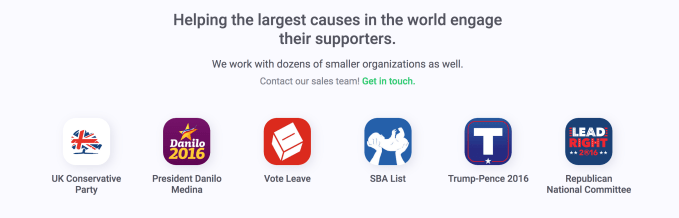
Another graphic on the same page plots the UK flag on a world map depicting what uCampaign dubs its “global platform”, where it’s marked along with several other European flags — including Ireland, France, Germany and Malta, suggesting uCampaign has — or had — multiple European clients.

Here’s the full list of questions we put to the Conservatives about their campaigner app. To our eye it has answered just one of them:

Can you confirm — on the record — the reasons for the app being pulled?

Does the Conservative Party intend to continue working with uCampaign for the new campaign app that will relaunch next year? Or does the party have a new supplier?

If the latter, where is the new supplier based? In the UK or in the US?

Did the Conservative Party have any concerns at all related to using uCampaigner as a supplier? (Given, for example, concerns flagged about its data privacy practices by one of the DCMS committee’s recent reports — following an inquiry investigating digital campaigning.)

If the Conservative Party was aware of data privacy concerns pertaining to uCampaign’s practices can you confirm when the party became aware of such concerns?

Was the party aware that the privacy policy it used for the app prior to May 23, 2018 was uCampaign’s own privacy policy?

This privacy policy stated that the app could harvest data from users’ mobile phone contacts and share that data with unknown third parties of the developer’s choosing — including other political campaigns. Is the Conservative Party comfortable with having its supporters’ data shared with other political campaigns?

What due diligence did the Conservative Party carry out before it selected uCampaign as its app supplier?

After signing up the supplier, did the Conservative Party carry out a privacy impact assessment related to how the app operates?

Please confirm all the data points that the app was collecting from users, and what each of those data points was being used for

Where was app user data being processed? In the US, where uCampaign is based, or in the UK where potential voters live?

If the US, what was the legal basis for any transfer of data from UK users to the US?

Is the Conservative Party confident its use of the campaigner app did not breach UK data protection law?

Earlier this year the former Cabinet Minister Dominic Grieve suggested that the bosses of tech giants involved in the Cambridge Analytica data misuse scandal should be jailed for their part in abusing online data for political and financial gain. Does the Conservative Party support Grieve’s position on online data abuse?

Has anyone been sacked or sanctioned for their part in procuring uCampaign as the app supplier — and/or overseeing the operation of the Conservative Campaigner app itself?

Will the Conservative Party commit to notifying all individuals whose data was shared with uCampaign without their explicit consent?

Can the Conservative Party confirm how many individuals had their personal data shared with uCampaign?

Has the Information Commissioner’s Office raised any concerns with the Conservative Party about the Campaigner app?

Has the Conservative Party itself reported any concerns about the app/uCampaign to the ICO?


from Social – TechCrunch https://ift.tt/2JweEeS Read More Detail!
,

drawSQL – Better entity relationship diagrams for your databases


drawSQL is better entity relationship diagrams for your databases. As a developer, the first step in building a new feature is always to visualise the database schema using an entity relationship diagram. Existing tools like MySQL workbench works for diagramming, but it glitches often and could use a UI refresh. Also, most of these tools are works offline as standalone apps, making it harder to collaborate on the database diagram in a team setting.

drawSQL's mission is to solve these and be the better online tool for developers to create, visualize and collaborate on their entity relationship diagrams.

View startup


from BetaList - Discover tomorrow's startups, today https://ift.tt/2qmllHF Read More Detail!

Tool up for the midterms with this Facebook junk news aggregator

With the US midterms fast approaching purveyors of online disinformation are very busy indeed spreading their hyper-partisan junk on Facebook.

Their goal: Skewing democratic outcomes by putting out misleading, deceptive or incorrect information that’s packaged as real news about politics, economics or culture — yet presented in a way that panders to prejudices and is more likely to get virally spread on mainstream social media platforms where it has the chance to influence people’s views.

This has happened before; is still happening; and will keep on happening unless or until social media platforms get properly regulated.

In the meanwhile, what’s to be done? Arming yourselves and your friends with smart digital and news literacy tools to help shine a light on the kind of ridiculously over-inflated political nonsense that’s being passed around on all sides (albeit, not necessarily equally) seems like a good place to start.

Step forward, Oxford University’s Oxford Internet Institute (OII), which has just launched an aggregator tool which tracks what it terms “junk” political views being shared on Facebook — doing so in near real-time and offering various ways to visualize and explore the junk heap.

What’s “junk news” in this context? The OII says this type of political content can include “ideologically extreme, hyper-partisan, or conspiratorial news and information, as well as various forms of propaganda”.

This sort of stuff might elsewhere get badged ‘fake news’, although that label is problematical — and has itself been hijacked by known muck spreaders. (So ‘online disinformation’ tends to be the label of choice in academic and policy circles, these days.)

The OII is here using its own political propaganda content categorization — i.e. this term “junk news” — which is based on what it describes as “a grounded typology” derived through analyzing a large amount of political communications shared by US social media users.

Specifically it’s based on an analysis of 21.8 million tweets sent during the 2016 Presidential campaign period up til the 2018 State of the Union Address in the United States — applying what the Institute dubs “rigorous coding and content analysis techniques to define the new phenomenon”.

This involved labelling the source websites of shared links based on “a grounded typology that has been tested over several elections around the world in 2016-2018”, with a content source getting coded as a purveyor of junk news if it failed on 3 out of 5 of criteria of the typology.

(Examples of sources that are being judged junk via this method include the likes of Breitbart, Dailycaller and Dailywire to name just a few.)

Now to the tool itself:

The Visual Junk News Aggregator does what it says on the tin, aggregating popular junk news posts into a bipartisan thumbnail wall of over-inflated (or just out and out) BS.

Complete with a trigger warning for the risk of graphic images and language. Mousing over the thumbnails brings up any title and description that’s been scraped for the post in question, plus a date stamp and full Facebook reaction data.

Another tool — the Top 10 Junk News Aggregator — shows the most engaged with English language junk news stories posted to Facebook in the last 24 hours, in the context of the 2018 US midterm elections. (With engagement being based on total Facebook reactions per second of the post’s life.)

While the full aggregator tool supports keyword searches of the junk heap (by content and/or publisher), and also by time — allowing for sifting of junk posts published to public Facebook pages as recently as the last hour or up to a full month old.

Returned search results can be further sorted by time and reaction — across all eight types of possible Facebook reactions.

“The Junk News Aggregator is an interactive tool for exploring junk news stories posted on Facebook, particularly useful right now in the lead-up to the US midterms,” the Institute writes. “It is a  unique tool for systematically studying misinformation on Facebook in real time. It make visible the depth of the junk news problem, displaying the quantity and the content of junk news, as well as the levels of engagement with it.

“Junk news content can be sorted by time and by engagement numbers, as well as via keyword search (such as for a candidate, district, or specific issue). It also offers a visual overview and a top-10 snapshot of the day’s most engaged-with junk news.

“Our goal is to help shed light on the problem of junk news on social media, to make this issue more transparent, and to help improve the public’s media literacy. It also aims to help journalists, researchers, policy-makers, and social media platforms understand the impact of junk news on public life.”

It sent us a case study example to help demonstrate the “functionality and usefulness” of the tool (based on a search it conducted at 11:00am GMT, October 31, 2018).

For this example it used the search keyword “caravan”, selecting posts from the last day and filtering for the most shared posts — which served up several posts.

The most shared post was this one, below, from junk news source Chicks on the Right:

The Institute doesn’t make any comment on why it chose to track junk news on Facebook, specifically, vs other social media platforms (e.g. Twitter) — though there’s little doubt that Facebook’s platform remains the kingpin where skewing political views is concerned, given its massive user-base.

Meanwhile the company’s ongoing attempts to dampen the virality of democracy-denting junk shared on its platform continue — and continue to yield underwhelming results, given the size and gravity of the problem.

Also unconvincing: Facebook’s extremely recent attempts to install systems that verify the actual identity of political advertisers on its platform. Yet these self-imposed checks look to be off to a terrible start — as Facebook has just been shown hosting (and spreading) yet more fake information… ouch…

Putting your faith in Facebook to sort its shit out on the political front — and fast — looks about as sensible as trusting your pet turtle to a shark to babysit.

Much better to tool up and seek to stay on top of the junk heap yourself — at least until the world’s political representatives sort their shit out and get a proper handle on regulating social media.

In the meanwhile, don’t forget to vote.


from Social – TechCrunch https://ift.tt/2P0kXxb Read More Detail!
,

Diagramiq – Create any type of diagram and collaborate with your team


Diagramiq is the perfect tool to capture and connect your ideas into beautiful diagrams with unbeatable speed and ease. It offers a great collection of shape libraries with virtually unlimited styling options for creating Flowcharts, UML Models, BPMN, Network Diagrams, Decision Trees and other unique diagrams.

View startup


from BetaList - Discover tomorrow's startups, today https://ift.tt/2AGUT1g Read More Detail!
,

Discovr.y – AR Discovery & Exploration Game


Discovr.y is an Augmented Reality discovery & exploration game that helps you find relevant experiences in your city & earns you redeemable tokens for your discovery actions around a city (checking-in & leaving a review).

Our gamified & social features allow you to be fully immersed in an exploration journey which motivates you to see every corner of your city & the rest of the world & experience everything that makes the world exciting. Challenge yourself, your friends & others in your city to reach the top spot in City Discovery % on our Leaderboard, spend your hard earned tokens on value deals from establishments in our Deals of the Day section & track your discovery progress in our Life Stats section.

View startup


from BetaList - Discover tomorrow's startups, today https://ift.tt/2SvH6Sd Read More Detail!
,

Aces – A visual messenger for social sharing


Aces is a fun way to turn any combination of pics, videos, links, and GIFs into one message. That message becomes a canvas where you and your friends (and other people, if you want) can add text, stickers, and draw right on. You can swipe through those reactions in such an interactive way that your response to a post becomes seemingly part of the post.

We believe social media should be fun and pressure-free. Because of this, you won’t find any social metrics (followers, likes, etc) on Aces. You can post stuff just because you like it – a popularity contest is never part of the equation. And, you can look at other posts just because you want to – not because they are trending or popular.

View startup


from BetaList - Discover tomorrow's startups, today https://ift.tt/2CTZ3Ew Read More Detail!