Thursday, 2 August 2018

,

Fund$nap – Personal finance application to show you safe monthly spending


Fund$nap is a personal finance mobile application that delivers a quick snapshot of your monthly free cash flow. Fund$nap makes an everything simple and easy - pulling transactions securely and automatically from your bank/credit account and auto-categorizing each transaction. Fund$nap allows you to have multiple accounts and to view each account individually or as a whole. Want to know your free cash balance between multiple account - Fund$nap is the answer. Please check out our website (http://www.fundsnapnmn.com) for more information. Join us and Take Control of Your Monthly Free Cash!

View startup


from BetaList - Discover tomorrow's startups, today https://ift.tt/2O2XHd1 Read More Detail!
,

Good Day – Tool for self improvement and reflection


Good Day is an app dedicated to help users improve themselves by giving them an overview of their past days. Users can add entries of good or bad days, and pinpoint the key events during each day that made the day good or bad. The app will then brief the user the next morning with said key points of the previous day. As you have more and more good days, you unlock in-app rewards, such as free ad removal.

View startup


from BetaList - Discover tomorrow's startups, today https://ift.tt/2n8c58s Read More Detail!
,

Tagrax – A tag based search engine


Tagrax is building a tag based search engine. Our vision is to revolutionize the way searches are done on the internet. We want to provide a more user friendly search engine for mobile users. We want to allow users to search the internet either using a single tag or a combination of tags.

Our app currently allows a user to search the internet using just a single tag/hashtag. It allows a user to watch/follow tags so they can get notified when its trending. It also allows for users to discover tags and helps them navigate easily through the world of tags.

View startup


from BetaList - Discover tomorrow's startups, today https://ift.tt/2LZ25fA Read More Detail!
,

Hangerang – Make Hangs, connect with friend, make new friends


Hangerang is a new social app that will help users re-connect with old friends and make new ones while sharing experiences with each other in the real world. Hangs can be Invite Only, open to 1st and 2nd degree Friends, or fully Public. Try a new restaurant. See what's happening in a new city. No hang is too lofty or mundane.

View startup


from BetaList - Discover tomorrow's startups, today https://ift.tt/2Kni0j3 Read More Detail!

Facebook launches a digital literacy library aimed at educators

Facebook this morning announced the launch of a new set of educational resources focused on helping young people think critically and behave thoughtfully online. The Digital Literacy Library, as the new site is being called, is aimed at educators of children aged 11 to 18, and address topics like privacy, reputation, identity exploration, security, safety, wellbeing and more.

There are 830 million young people online, the company notes, which is why digital literacy is necessary. We’ve seen the results what can happen when people are lacking in digital literacy – they’re susceptible to believing hoaxes, propaganda and fake news is true; they risk their personal data by using insecure apps; they become addicted to social media and its feedback loop of likes; they bully and/or are bullied; and they don’t take steps to protect their online reputation which can have real-world consequences, to name a few things.

However, many teachers today lack the educational resources that would allow them to teach a digital literacy program in their classroom, or in other less formal environments.
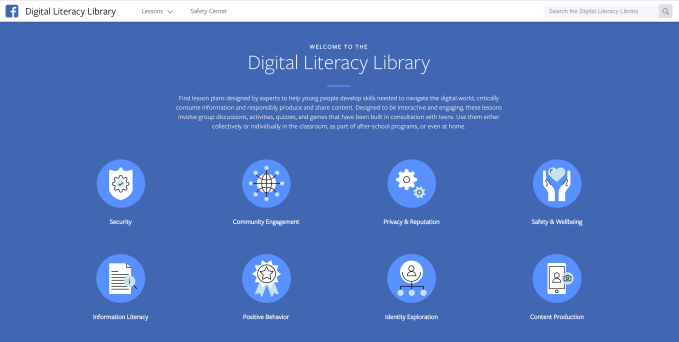
Facebook says the lesson plans in the new library were drawn from the Youth and Media team at the Berkman Klein Center for Internet & Society at Harvard University, where they were released under a Creative Commons license. In other words, the company itself did not design the lessons, it’s only making them more broadly available by placing them on Facebook where they can be more easily discovered and used.

The lessons themselves are based on over 10 years of academic research from the Youth and Media team, who also took care to reflect the voices of young people from diverse socioeconomic backgrounds, ethnicities, geographies, and educational levels, Facebook says. Initially, the 18 lessons are launching in English, but they’ll be soon available in 45 additional languages.

For educators, the lessons are ready-to-use as free downloads, and state how long each lesson will take. Outside the classroom, parents could use them to teach children at home, or they could be used in after-school programs. Teachers can also modify the lessons’ content to meet their own needs, if they choose.

The courses will be made available in Facebook’s Safety Center and Berkman Klein’s Digital Literacy Resource Platform for the time being. Facebook says it’s also working with other non-profits worldwide to adapt the lessons and create new ones.

This isn’t the first time Facebook has offered educational resources aimed at young people.

The company also recently launched its Youth Portal, which provides educational material directly to teens, not their teachers. However, those resources are focused more on Facebook itself, providing guidance on things like how to navigate the service, how to stay secure, and how to understand how people’s data is used. (Arguably, this sort of information is something a large number of adults could use a refresher on, as well.)

In addition, Facebook has begun to roll out educational guidance into its new app, Messenger Kids, aimed at the under-13 crowd. The app encourages children to be kind and respectful online, by promoting empathy and positive messaging through things like the “Messenger Kids Pledge,” kindness stickers, and other in-app challenges.

At the root of all this is the fact that Facebook, along with most social media, has corrupted the way people interact and navigate the online world. And it is now belatedly is waking up to its role and its responsibilities on that front. These large platforms were built by optimistic engineers who for years only saw the positive side of connecting the online world, and not the potentially negative outcomes – like data theft and misuse, fake news, hacking, attempts to disrupt democracy, bullying, targeted harassment, and even genocide. A literacy program could help the next generation of users, but it has arrived too late for many of Facebook’s users.

Below, are the lesson plans’ description, for reference:


from Social – TechCrunch https://ift.tt/2OCa5BP Read More Detail!
,

Gitweet – Tweet From Your Commit Description


Gitweet is a convenient tool for developers and makers that wants to quickly tweet something about their last code update.

Once your repository is linked to a twitter account, every time you provide a description in a commit (completely optional obviously), a tweet will be posted with the provided content. Only the description will be tweeted.

View startup


from BetaList - Discover tomorrow's startups, today https://ift.tt/2O5TFAy Read More Detail!

Instagram’s CEO on vindication after 2 years of reinventing Stories

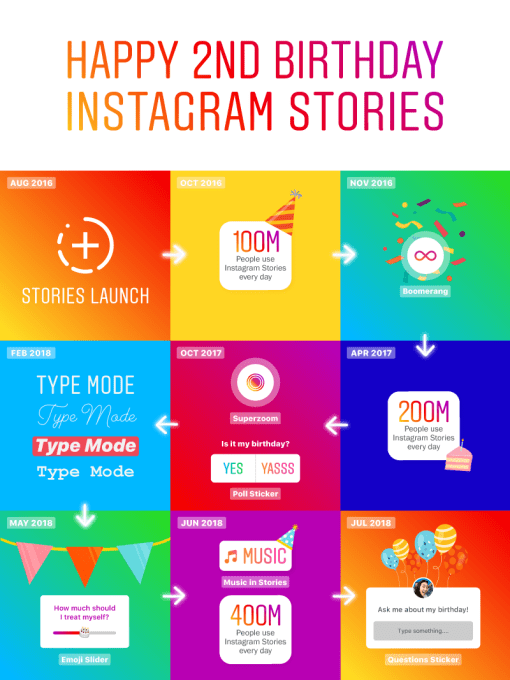
“I think the mistake everyone made was to think that Stories was a photography product” says Instagram CEO Kevin Systrom. “If you look at all these interactivity features we’ve added, we’ve really made Stories something else. We’ve really innovated and made it our own.”

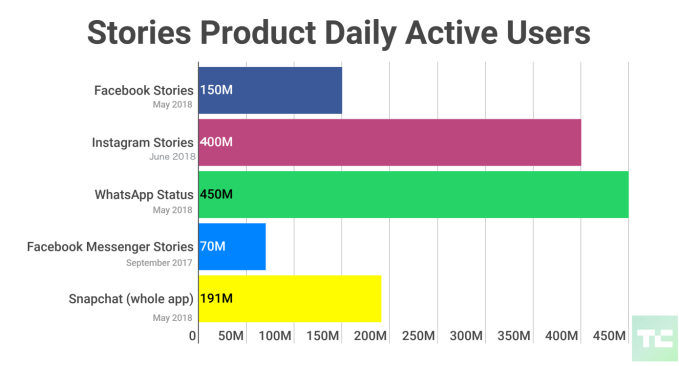
His version of the ephemeral slideshow format turns two years old today. By all accounts, it’s a wild success. Instagram Stories has 400 million daily users, compared to 191 million on Snapchat which pioneered Stories. While the first year was about getting to parity with augmented reality filters and stickers, the two have since diverged. Instagram chose the viral path.

Snapchat has become more and more like Photoshop, with its magic eraser for removing objects, its green screen-style, background changer, scissors for cut-and-pasting things, and its fill-in paint bucket. These tools are remarkably powerful for living in a teen-centric consumer app. But many of these artistic concepts are too complicated for day-to-day Snapping. People don’t even think of using them when they could. And while what they produce is beautiful, they get tapped past and disappear just like any other photo or video.

Instagram could have become Photoshop. Its early photo-only feed’s editing filters and sliders pointed in that direction. Instead, it chose to focus not on the “visual” but the “communication”. Instagram increasingly treats Stories as a two-way connection between creators and fans, or between friends. It’s not just one-to-many. It’s many-to-one as well.

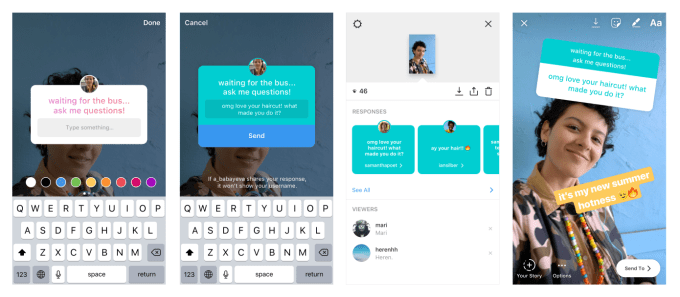
Instagram Stories arrived three years after Snapchat Stories, yet it was the first to let you tag friends so they’d get a notification. Now those friends can repost Stories you tag them in, or public posts they want to comment on. You could finally dunk on other Instagrammers like you do with quote-tweets. It built polls with sliders friends can move to give you feedback about “how ridiculous is my outfit today?” Music stickers let you give a corny joke a corny soundtrack or share the epic song you heard in your head while looking out upon a beautiful landscape. And most recently, it launched the Question sticker so you can query friends through your Story and then share their answers there too. Suddenly, anyone could star in their own “Ask Me Anything”.

None of these Instagram tools require much ‘skill’. They’re designed not for designers, but for normal people trying to convey how they feel about the world around them. Since we’re social creatures, that perception is largely colored by their friends or audience. Instagram lets you make them part of the Story. And the result is a product that grabs non-users or casual users and pulls them deeper into the Instagram universe, exposing people to the joy of creating something the last until tomorrow, not always forever. “We believe the future is the combination of feed and Stories” Systrom says.

Mimicking Photoshop reinforces the idea that everything has to look polished. That’s the opposite of what Systrom was going for with the launch of Instagram Stories. “There will always be an element in any public broadcast system of trying to show off” Systrom explains. “But what I see is it moving in the other direction. GIF stickers allow you to be way more informal than you used to be. Type mode means now people are just typing in thoughts rather than actually taking photos. Things like Superzoom with the TV effect or the beats — it’s anything but polished. If anything it’s a joke. Quantitatively people feel comfortable to post way more stories than to feed.”

That sense of comfort powered by Instagram purposefully pushing Stories to diverge from its classy feed has contributed to its explosion in popularity — not just for Stories but Instagram as a whole. It now has over 1 billion users, in part driven by it introducing Stories to developing countries Snapchat never penetrated.

“Remember how at the launch of Stories, I said it was a format and we want to make it original? And there was a bunch of criticism around us adopting this format? My response was this is a format and we’re going to innovate and make it our own. The whole idea there is to make it not just about photography but about expression. It’s a canvas for you to express yourself.”

Last week when Facebook announced its revenue was decelerating as users shifted attention from its lucrative News Feed to Stories, its share price tanked deleting $120 billion in market cap. Yet imagine how much further it would have dropped if Systrom hadn’t been willing to put his pride aside, take Snapchat Stories, and give it the Insta spin? Instead, it led the way to Facebook now having over 1.1 billion (duplicated) daily Stories users across its apps

So does he feel vindicated in that once-derided decision? “I don’t wake up everyday trying to feel vindicated. I wake up everyday trying to make sure our billion users have amazing stuff to use. I just feel lucky that they love what we produce” Systrom says with a laugh. “I don’t know if that fits your definition of vindicated.”


from Social – TechCrunch https://ift.tt/2OCHPz2 Read More Detail!
,

Bulletin.chat – Create and publish interactive newsletters for Telegram and Facebook Messenger


Bulletin.chat is a CMS that helps publishers easily compose and distribute content for messaging platforms. Like "Mailchimp for Messaging," Bulletin.chat helps automate connections with readers on messaging apps, while providing publishers with analytics that are not otherwise available via this “dark social” channel. Currently, our platform runs on Telegram Messenger and Facebook Messenger, and enable publishers and content creators to convert stories into guided conversations that open the doors to increased engagement and new monetization strategies.

Distributing content on messaging apps allows publishers to regain control of distribution channels while creating one-on-one relationships with readers. Messaging apps are now more widely used than social media, and engage users for longer. Bulletin.chat taps into this, and offers a direct, effective way of growing readership, driving website traffic, and sharing content without restrictive social algorithms getting in the way.

View startup


from BetaList - Discover tomorrow's startups, today https://ift.tt/2MeJg4W Read More Detail!
,

House of Anesi Inc. – A bra that adapts to breast size changes and reduces back pain


House of Anesi has designed a bra that can adapt to women's breast size changes and reduce back pain. We use dual compression zone technology in order for the fabric to adapt to the women's breast size, 3D Flexi wires and biocompatible, non-toxic gel straps that release pressure points. We are launching on Kickstarter on July 31st to start accepting pre-orders for our first production run of 1000 bras.

View startup


from BetaList - Discover tomorrow's startups, today https://ift.tt/2M8Gy0P Read More Detail!

Wednesday, 1 August 2018

,

Release Work – GitHub-Powered Release Server for Squirrel, Electron.js and more


Release Work turns your GitHub repository into a release server. We provide an API you can use to interact with your application's releases, provide a Download link API and support the Squirrel Update framework to create automated app updates.

Furthermore you can view download stats, create a landing page for your app and connect with your app's users (coming soon).

View startup


from BetaList - Discover tomorrow's startups, today https://ift.tt/2Aw9z5t Read More Detail!