Wednesday, 1 August 2018

,

HTML Resume – Beautifully hand-crafted, single-page responsive HTML resume & CV templates


HTML Resume has a collection of beautiful and hand-crafted, single-page responsive HTML resume & CV templates for as low as $5.

Stand out from the crowd with one of our resume designs!

View startup


from BetaList - Discover tomorrow's startups, today https://ift.tt/2LOsjT2 Read More Detail!
,

GTAG – An easy way to share your location via Google Maps


Gtag.me is a super simple tool that aids you to mark your location and pass on the details with a click of a button.How it works? A few simple steps is all it takes. Look up your location on the map on the gtag.me site, zoom into your exact location and name your place. Give directions, landmarks and indicate other helpful tips. Sign in once and share a million times!

How is diff to Google Maps? You get your own private short vanity URL, you only sign once and can easily share it as many times as you want. Sign up is less than 30 secs. You can add your own image like a Google business listing. Changing is super easy when you log in and changes are instant!

View startup


from BetaList - Discover tomorrow's startups, today https://ift.tt/2n4kPMU Read More Detail!

Facebook loses its chief security officer Alex Stamos

Alex Stamos, Facebook’s chief security officer since 2015, is leaving the company to take a position at Stanford University. The company has been shedding leadership over the last half a year largely owing to fallout from its response, or lack thereof, to the ongoing troubles relating to user data security and election interference on the social network.

Rumors that Stamos was not long for the company spread in March; he was said to have disagreed considerably with the tack Facebook had taken in disclosure and investigation of its role in hosting state-sponsored disinformation seeded by Russian intelligence. To be specific, he is said to have preferred more and better disclosures rather than the slow drip-feed of half-apologies, walkbacks, and admissions we’ve gotten from the company over the last year or so.

He said at in March that “despite the rumors, I’m still fully engaged with my work at Facebook,” though he acknowledged that his role now focused on “emerging security risks and working on election security.”

Funnily enough, that is exactly the topic he will be looking into at Stanford as a new adjunct professor, where he will be joining a new group called Information Warfare, the New York Times reported.

Leaving because of a major policy disagreement with his employer would not be out of character for Stamos. He reportedly left Yahoo (which of course was absorbed into Aol to form TechCrunch’s parent company, Oath) because of the company’s choice to allow U.S. intelligence access to certain user data. One may imagine a similar gulf in understanding between him and others at Facebook, especially on something as powerfully divisive as this election interference story or the Cambridge Analytica troubles.

Stamos is far from the only Facebook official to leave recently; Colin Stretch, chief legal officer, left last month after more than eight years at the company; its similarly long-serving head of policy and comms, Elliot Schrage, left the month before; WhatsApp cofounder Jan Koum left that company in April.

We’ve contacted Facebook and Stamos for comment and will update this post when we hear back.


from Social – TechCrunch https://ift.tt/2vtuksD Read More Detail!

PSA: Automatic cross-posting tweets to Facebook no longer works as of today

You can no longer automatically cross-post your tweets to Facebook. Twitter announced today that functionality is now coming to an end, and users will instead have to copy a tweet’s URL if they want to share a tweet to Facebook going forward. In a statement, the company attributed the change to a recent Facebook update.

Specifically, the issue has to do with Facebook’s lockdown of its API platform – an overhaul that’s been underway following the Cambridge Analytica scandal, where as many as 87 million Facebook users had their data improperly harvested and shared.

Since then, Facebook has been plugging holes in its API platform to prevent future data misuse. One of those changes involves Facebook Login, announced back in April. The company said that apps that had been granted permission to publish posts to Facebook as the logged-in user would no longer have that permission. New apps wouldn’t be able use this feature the day the change was announced. And in the case of older apps, the permission would be revoked on August 1, 2018  – that’s today.

Facebook also said developers who were previously using the API could instead turn to Facebook’s Share dialogs for webiOS and Android. But Twitter’s statement didn’t mention there would be an alternative means of sharing built back into Twitter, beyond using its existing “Copy link to Tweet” feature. This is a manual way of sharing tweets, of course, and not a replacement for what is being lost.

The option to set up Facebook sharing hasn’t completely disappeared from Twitter’s app as of yet.

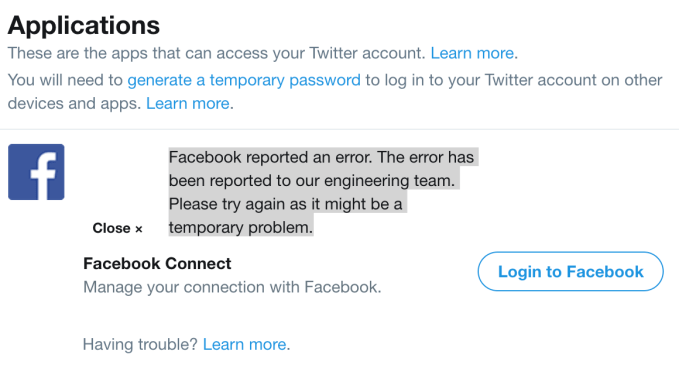
Facebook still appears within the “Apps” section via the web, with the button “Login to Facebook” seemingly waiting to be clicked. However, this option will no longer work as of today. Instead, it returns the error: “Facebook reported an error. The error has been reported to our engineering team. Please try again as it might be a temporary problem.”

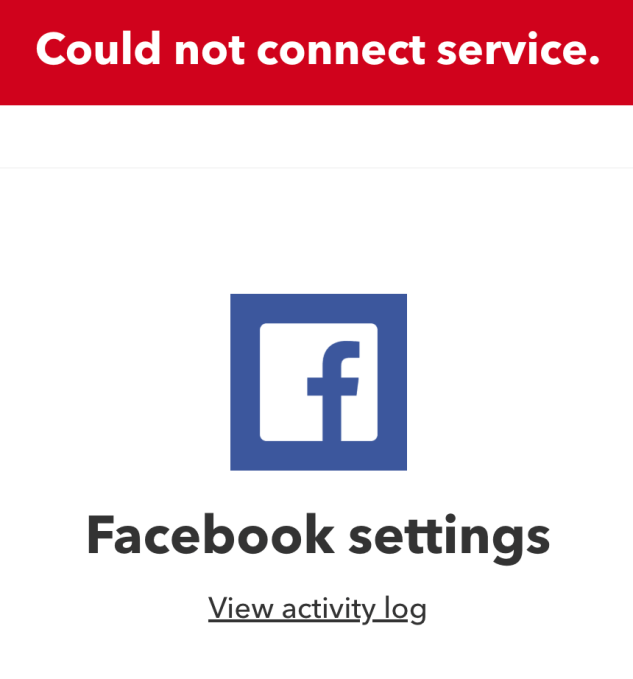
It doesn’t seem like Twitter users looking for other workarounds will have much success either, given this situation. Other apps, like IFTTT, for example, are throwing errors as of today, too.


from Social – TechCrunch https://ift.tt/2NZf3HF Read More Detail!

Activists push back on Facebook’s decision to remove a DC protest event

A number of activists and organizers in the Washington DC area are disputing Facebook’s decision to remove a counter-protest event against a rally organized by Jason Kessler, the white nationalist figure who planned the deadly 2017 rally in Charlottesville, Virginia.

Facebook removed the event, “No Unite the Right 2-DC,” after discovering that one account connected to the event exhibited what Facebook calls “coordinated inauthentic behavior.” The company defines this activity as “people or organizations creating networks of accounts to mislead others about who they are, or what they’re doing.”

The Facebook page at the center of the controversy was called “Resisters.” TechCrunch confirmed that the Resisters page was created by “bad actors,” as defined by the company, who coordinated fake accounts to deceive users. Facebook ultimately removed the No Unite the Right 2-DC event due to its known interaction and engagement with the Resisters page and maintains that Resisters was an illegitimate page from its inception.

As the company explained in its blog post:

“The “Resisters” Page also created a Facebook Event for a protest on August 10 to 12 and enlisted support from real people… Inauthentic admins of the “Resisters” Page connected with admins from five legitimate Pages to co-host the event.”

The company also observed that a known Internet Research Agency (IRA) account joined the counter-protest event as an admin, though it only served as an admin for seven minutes. (The IRA has been assessed by the U.S. intelligence community as a content farm likely funded by a close Putin ally with ties to Russian intelligence.) On top of that, Facebook noted that an IRA account the company was aware of shared a Facebook event hosted by Resisters in 2017.

Here’s where things get even more tricky. The event that Facebook deleted had been taken over by a handful of real DC area activist groups. These groups, including Smash Racism DC, Black Lives Matter DC, Black Lives Matter Charlottesville and other local groups, worked together under the coalition name “Shut It Down DC” and their actions and plans were not inspired by the “No Unite the Right 2” event, they just happened to cross paths. (Since then, the coalition has recreated the Facebook event as “Hate Not Welcome: No Unite The Right 2.”)

TechCrunch spoke with a handful of DC-based organizers including Andrew Batcher, a Washington DC-based activist involved with Shut It Down DC, to clarify how the local coalition of organizers became connected to an event and an account deemed illegitimate by Facebook.

“It was grassroots organizing from a lot of different groups who were interested in this,” Batcher said. “A lot of groups went down to Charlottesville last year. Charlottesville is only two hours south of DC.”

He explains that the group’s impetus was Kessler’s own event, not a Facebook event that organizers stumbled onto.

“When we started organizing we talked about making a Facebook page and saw that this already existed,” Batcher said. “It happens pretty regularly in DC knowing how many major events take a place here.”
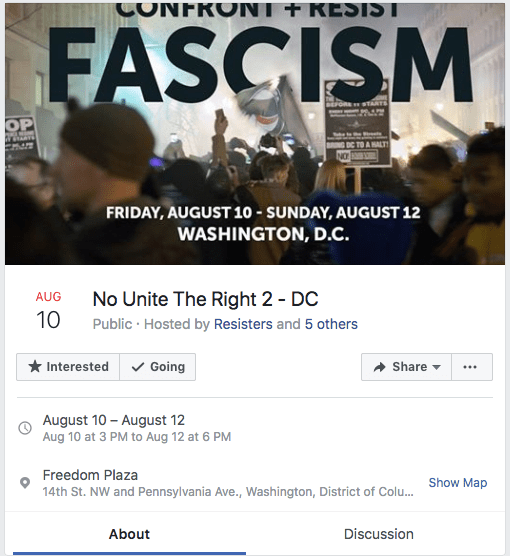
“We asked to be made co-hosts of the event and we put our stuff up on it basically,” Batcher said. That included video calls to action, photos and other content, including the event description. “Everything that was taken down was ours.”

Beyond creating the initial placeholder page, Batcher says that the Resisters page had “absolutely no involvement” in the event.

“This is really outrageous for us,” Batcher said. “[It] makes it look like we’re Russian pawns. We know that we’re not, and we know that we’ve been doing this organizing.”

He and other activists on the left have expressed concerns that this depiction could undermine their efforts in the mainstream and even lead to conspiracy theories like Pizzagate that spill over into real life violence.

Facebook says that it reached out to the legitimate organizers of No Unite The Right 2-DC with the following message:

We haven’t been able to connect on the phone yet, but I did want to make sure you know that earlier today we removed a Facebook event that you are listed as a co-host of, “No Unite the Right 2 – DC”, because one the Pages that created the event, “Resisters”, has been removed from Facebook because [it] was created by someone establishing an inauthentic account that has been associated with coordinated inauthentic behavior.

“I understand this may be surprising or frustrating. We are reaching out to make sure you have the relevant information and understand that this has nothing to do with you or your Page. Later today, we’ll begin providing information about the event deletion to the approximately 2,600 users who indicated their interest in the event, and the 600 plus users that said they’d attend. If you are interested in setting up another event, we would be happy to include details about it in our public communications.”

According to Batcher, most of the event’s organizers with Shut It Down DC did not receive any correspondence and others received an email “two lines long” which he provided.
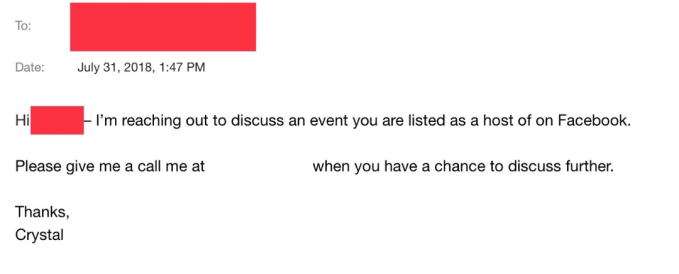
The group is dismayed that Facebook went ahead and removed the event before making contact with more of its real organizers. In interviews with TechCrunch, he and other organizers expressed a deep distrust of Facebook and a desire to see more evidence from company that supports its recent actions. One organizer connected to the DC groups expressed concern that Facebook might be flagging activists working together using VPNs for suspicious coordinated activity. When asked about that concern, Facebook explained that VPN use and common privacy measures would not be would not be sufficient, by Facebook’s standards, to cause an account or page to be removed.

“If there was an account that did something bad, get rid of that account. It doesn’t seem to me like it would have to spread to all of this legitimate organizing,” Batcher said. He added that Facebook did not show “any kind of care” for the potential damage to those involved in putting the event together in real life.

“What we would like is a public apology and them letting people know that we are real people doing real organizing.”

That distrust is reflected on both sides of the political spectrum. Concerns that Facebook is censoring content made by right-wing figures have bubbled up in Congressional hearings and been floated among many users on the right. While there is little evidence that Facebook is in fact censoring right-leaning content, the company does have a checkered history with left-leaning groups, including some Black Lives Matter supporters and parts of the LGBTQ community.

In some of those cases, Facebook users were abusing the platform’s reporting tools for targeted harassment, but the company was slow to address concerns or to change its policy. Facebook has also dragged its feet in confronting openly abusive, racist content on its platform and recently faced criticism for internal policies that allow white nationalism while forbidding white supremacism, drawing what is widely considered to be an artificial distinction between the two. These woes don’t just affect Facebook, but the platform does appear to be a perfect storm for anyone acting in bad faith.

While the counter-protest organizers have since created a new Facebook event and intend to continue their efforts, the situation is a fairly unsettling cautionary tale of a rising form of manipulation on the world’s biggest social platform. Recent revelations and those from 2017 show that a new breed of “blended” social media influence campaign — fake accounts leveraging the efforts of real, regular people — proves particularly insidious.

So-called “bad actors” are infiltrating legitimate causes, creating chaos and throwing everything into question. Even when these efforts are exposed, it’s a winning formula for anyone seeking to sow further discord and doubt in the U.S. political landscape. For everyone else, the odds aren’t looking good.


from Social – TechCrunch https://ift.tt/2OBX1fK Read More Detail!
,

Quanta – Next generation of hybrid decentralized Crypto exchanges with a focus on security and speed


Quanta (quantadex.com), the plural of quantum, wants to become the next generation of hybrid decentralized exchanges for cryptocurrencies. Security and speed are built into the core allowing up to 4.5 million transactions per second. All transactions are saved on the blockchain so no credentials are stored in our servers, thus maximizing your asset protection.

We've been working closely with traders with one goal in mind: to make the best exchange ever created. Welcome to QUANTA. P.S: Free $250 to first 100K users who join us @ www.quantadex.com/invite

View startup


from BetaList - Discover tomorrow's startups, today https://ift.tt/2M6PofA Read More Detail!
WhatsApp finally earns money by charging businesses for slow replies

Today WhatsApp launches its first revenue-generating enterprise product and the only way it currently makes money directly from its app. The WhatsApp Business API is launching to let businesses respond to messages from users for free for up to 24 hours, but will charge them a fixed rate by country per message sent after that.

Businesses will still only be able to message people who contacted them first, but the API will help them programatically send “shipping confirmations, appointment reminders or event tickets. Clients can also use it respond to manually respond to customer service inquiries through their own tool or apps like Zendesk or Twilio. And small businesses who are one of the 3 million users of the WhatsApp For Business app can still use it to send late replies one-by-one for free.

After getting acquired by Facebook for $19 billion in 2014, it’s finally time for the 1.5 billion-user WhatsApp to pull its weight and contribute some revenue. If Facebook can pitch the WhatsApp Business API as a cheaper alternative to customer service call centers, the convenience of asynchronous chat could compel users to message companies instead of phoning.

Only charging for slow replies after 24 hours since a user’s last message is a genius way to create a growth feedback loop. If users get quick answers via WhatsApp, they’ll prefer it other channels. Once businesses and their customers get addicted to it, WhatsApp could eventually charge for all replies or any that exceed a volume threshold, or cut down the free window. Meanwhile, businesses might be too optimistic about their response times and end up paying more often than the expect, especially when messages come in on weekends or holidays.

WhatsApp first announced it would eventually charge for enterprise service last September when it launched its free WhatsApp For Business app that now has 3 million users and remains free for all replies, even late ones.

Importantly, WhatsApp stresses that all messaging between users and businesses, even through the API, will be end-to-end encrypted. That contrasts with the Washington Post’s report that Facebook pushing to weaken encryption for WhatsApp For Business message is partly what drove former CEO Jan Koum to quit WhatsApp and Facebook’s board in April. His co-founder Brian Acton had ditched Facebook back in September and donated $50 million to the foundation of encrypted messaging app Signal.

Today WhatsApp is also formally launching its new display ads product worldwide. But don’t worry, they won’t be crammed into your chat inbox like with Facebook Messenger. Instead, businesses will be able to buy ads on Facebook’s News Feed that launch WhatsApp conversations with them…thereby allowing them to use the new Business API to reply. TechCrunch scooped that this was coming last September, when code in Facebook’s ad manager revealed the click-to-WhatsApp ads option, and the company confirmed the ads were in testing. Facebook launched similar click-to-Messenger ads back in 2015.

Finally, WhatsApp also tells TechCrunch its planning to run ads in its 450 million daily user Snapchat Stories clone called Status. “WhatsApp does not currently run ads in Status though this represents a future goal for us, starting in 2019. We will move slowly and carefully and provide more details before we place any Ads in Status” a spokesperson told us. Given WhatsApp Status is over twice the size of Snapchat, it could earn a ton on ads between Stories, especially if it’s willing to make some unskippable.

Together, the ads and API will replace the $1 per year subscription fee WhatsApp used to charge in some countries but dropped in 2016. With Facebook’s own revenue decelerating, triggering a 20 percent, $120 billion market cap drop in its share price, it needs to show it has new ways to make money now more than ever.


from Social – TechCrunch https://ift.tt/2NZwack Read More Detail!
Snapchat launches its first speech recognition lenses

Snapchat is today launching new lenses that respond to voice commands. The company says it’s now rolling out a series of lenses that will animate when users speak simple, English words like “hi,” “love,” “yes,” “no,” and “wow,” as opposed to taking some other action – like opening their mouth or raising their eyebrows, as has been the trigger for some of the company’s prior lenses that animate with special effects.

For example, saying “hi” in the new lens will launch an animation that surrounds you with a flock of chatty birds; “love” will play cheesy jazz music; “yes” creates a zoom effect; “no” puts you in an infinite photo tunnel; and “wow” puts a bow on your head and surrounds you with the word.

While the company has offered lenses that involve audio before, this is the first time it has created lenses that actually recognize words, then use its understanding of what was said as a marker that kicks off the lens animation.

Snapchat says it will begin to make around five to six of these new lenses available to users within the next week. They’ll appear periodically in the Lens carousel along with the others, starting today, Wednesday August 1st.

The lenses will prompt users how to trigger the animation, when launched, Snapchat says.

Unique lenses have always been one of Snapchat’s biggest differentiators. And it has continually pushed the bar forward in this area by creating those that take advantage of camera technology and augmented reality in new ways. For example, it has launched things like World Lenses that add AR elements to any scene – including, more recently, Bitmoji – plus selfie games, lenses that can change the sky, paint the world around you, and more.

In May, it also launched the first lenses that react to sounds – but not particular words. The company says it’s possible for the new speech recognition lenses to be combined with its other lens technology, but it declined to say if that’s something it had planned.

The new lenses are also remarkably similar to the speech recognition triggered AR stickers found in the Panda video app, we should also note.

New lenses like this help to keep Snapchat users engaged, and could potentially turn into a technology that’s opened to advertisers further down the road, too.

The company may not have the size and scale of Facebook’s app empire (including also Messenger, Instagram and WhatsApp), but it does have the younger audience, who are increasingly ditching Facebook for other apps like Snapchat, YouTube and Instagram.


from Social – TechCrunch https://ift.tt/2M8l44k Read More Detail!
,

MarkShow – Create beautiful presentations using live markdown editor


MarkShow is Markdown to Slideshow powered by Reveal.js

How? - Write your presentation as Markdown text - Click on slide area to play - Press E to edit again - That's all

View startup


from BetaList - Discover tomorrow's startups, today https://ift.tt/2KhQuUh Read More Detail!

Facebook and Instagram now show how many minutes you use them

It’s passive zombie feed scrolling, not active communication with friends that hurts our health, according to studies Facebook has been pointing to for the last seven months. Yet it’s treating all our social networking the same with today’s launch of its digital wellbeing screentime management dashboards for Facebook and Instagram in the US before rolling them out to everyone in the coming weks.

Giving users a raw count of the minutes you’ve spent in their apps each day in the last week plus your average across the week is a good start to making users more mindful. But by burying them largely out of sight, giving them no real way to compel less usage, and not distinguishing between passive and active behavior, they seem destined to be ignored while missing the point the company itself stresses.

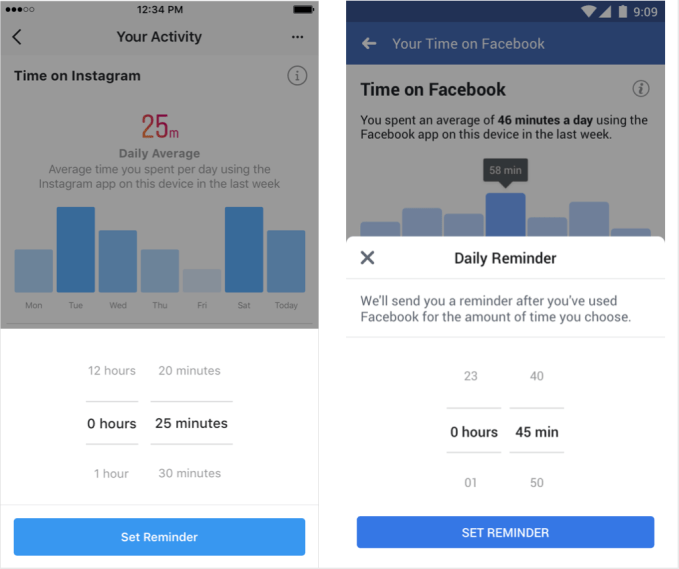
TechCrunch scooped the designs of the two separate but identical Instagram and Facebook tools over the past few months thanks to screenshots generated from the apps’ code by Jane Manchun Wong. What’s launching today is what we saw, with the dashboards located in Facebook’s “Settings” -> “Your Time On Facebook” and Instagram’s “Settings” -> “Your Activity”.

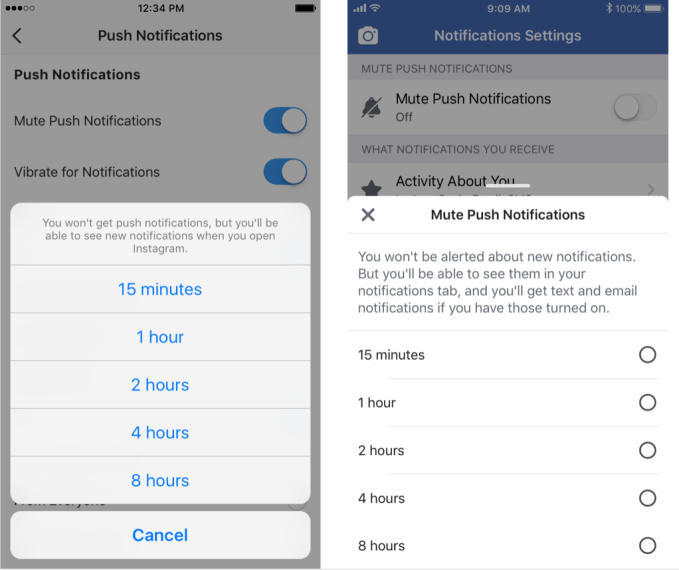
Beyond the daily and average minute counts, you can set a daily “limit” in minutes after which either app will send you a reminder that you’ve crossed your self-imposed threshold. But they won’t stop you from browsing and liking, or force you to dig into the settings menu to extend your limit. You’ll need the willpower to cut yourself off. The tools also let you mute push notifications (you’ll still see in-app alerts), but only for as much as 8 hours. If you want anything more permanent, you’ll have to dig into their separate push notification options menu or your phone’s settings.

The announcement follows Instagram CEO Kevin Systrom’s comments about our original scoop, where he tweeted “It’s true . . . We’re building tools that will help the IG community know more about the time they spend on Instagram – any time should be positive and intentional . . . Understanding how time online impacts people is important, and it’s the responsibility of all companies to be honest about this. We want to be part of the solution. I take that responsibility seriously.”

Users got their first taste of Instagram trying to curtai overuse with its “You’re All Caught Up” notices that show when you’ve seen all your feed posts from the past two days. Both apps will now provide callouts to users teaching them about the new activity monitoring tools. Facebook says it has no plans to use whether you open the tools or set daily limits to target ads. It will track how people use the tool to tweak the design, but it sounds like that’s more about what time increments to show in the Daily Reminder and Mute Notifications options than drastic strengthenings of their muscle.

“It’s really important for people who use Instagram and Facebook that the time they spend with us is time well spent” Ameet Ranadive, Instagram’s Product Director of Well-Being, told reporters on a conference call. “There may be some tradeoff with other metrics for the company and that’s a tradeoff we’re willing to live with, because in the longer term we think this is important to the community and we’re willing to invest in it.”

Facebook has already felt some of the brunt of the tradeoff. It’s been trying to improve digital wellbeing by showing fewer low quality viral videos and clickbait news stories, and more from your friends. That’s contributed to a flatlining of its growth in North America, and even a temporary drop of 700,000 users while it also lost 1 million users in Europe this past quarter. That led to Facebook’s slowest user growth rates in history, triggering a 20 percent, $120 billion market cap drop in its share price. “The changes to the News Feed back in January were one step . . . giving people a sense of their time so they’re more mindful of it is the second step” says Ranadive.

The fact that Facebook is willing to put its finances on the line for digital wellbeing is a great step. But it’s likely to be changes to the Facebook and Instagram feeds that prioritize content you’ll comment on rather than look at and silently scroll past that will contribute more to healthy social networking than today’s toothless tools.

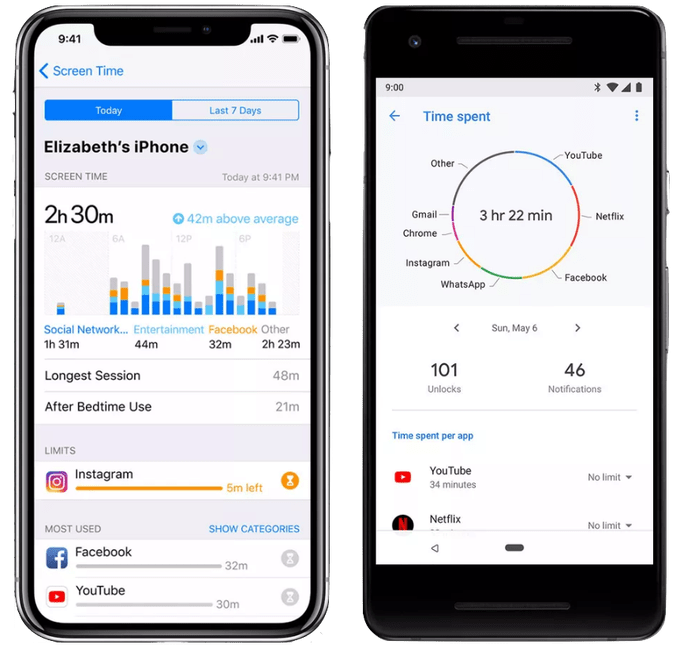
iOS Screen Time (left) and Android Digital Wellbeing (right)

While iOS 12’s Screen Time and Android’s new Digital Wellbeing features both count your minutes on different apps too, they offer more drastic ways to enforce your own good intentions. iOS will deliver a weekly usage report to remind you the features exist. Android’s is best-in-class because it grays out an app’s icon and requires you to open your settings to unlock an app after you exceed your daily limit.

To live up to the responsibility Systrom promised, Facebook and Instagram will have to do more to actually keep us mindful of the time we spend in their apps and help us help ourselves. Let us actually lock ourselves out of the apps, turn them grayscale, fade their app icons, or persistently show our minute count onscreen once we pass our limit. Anything to make being healthy on their apps something you can’t just ignore like any other push notification.

Or follow the research and have the dashboards actually divide our sharing, commenting, and messaging time from our feed scrolling, Stories tapping, video watching, and photo stalking. The whole point is that social networking isn’t all bad, but there are behaviors that hurt. Most of us aren’t going to give up Facebook and Instagram. Even just trying to spend less time on them is difficult. But by guiding us towards the activities that interconnect us rather than isolate us, Facebook could get us to shift our time in the right direction.


from Social – TechCrunch https://ift.tt/2AvBQJh Read More Detail!
,

Versus – Tools for your sports life


Versus helps sports organizations with powerful and easy to use communications, member management, scheduling and payment tools. We have simplified sports management to its core so you can focus on what's really important, having a successful season, tournament or camp.

View startup


from BetaList - Discover tomorrow's startups, today https://ift.tt/2LKwAqj Read More Detail!