Tuesday, 5 June 2018

The erosion of Web 2.0

It seems quaint to imagine now but the original vision for the web was not an information superhighway. Instead, it was a newspaper that fed us only the news we wanted. This was the central thesis brought forward in the late 1990s and prophesied by thinkers like Bill Gates – who expected a beautiful, customized “road ahead” – and Clifford Stoll who saw only snake oil. At the time, it was the most compelling use of the Internet those thinkers thought possible. This concept – that we were to be coddled by a hive brain designed to show us exactly what we needed to know when we needed to know it – continued apace until it was supplanted by the concept of User Generated Content – UGC – a related movement that tore down gatekeepers and all but destroyed propriety in the online world.

That was the arc of Web 2.0: the move from one-to-one conversations in Usenet or IRC and into the global newspaper. Further, this created a million one-to-many conversations targeted at tailor-made audiences of fans, supporters, and, more often, trolls. This change gave us what we have today: a broken prism that refracts humanity into none of the colors except black or white. UGC, that once-great idea that anyone could be as popular as a rock star, fell away to an unmonetizable free-for-all that forced brands and advertisers to rethink how they reached audiences. After all, on a UGC site it’s not a lot of fun for Procter & Gamble to have Downy Fabric Softener advertised next to someone’s racist rant against Muslims in a Starbucks.

Still the Valley took these concepts and built monetized cesspools of self-expression. Facebook, Instagram, YouTube, and Twitter are the biggest beneficiaries of outrage culture and the eyeballs brought in by its continuous refreshment feed their further growth. These sites are Web 2.0 at its darkest epitome, a quiver of arrows that strikes at our deepest, most cherished institutions and bleeds us of kindness and forethought.

So when advertisers faced either the direct monetization of random hate speech or the erosion of customer privacy, they choose the latter. Facebook created lookalike audiences that let advertisers sell to a certain subset of humanity on a deeply granular level, a move that delivered us the same shoe advertisement constantly, from site to site, until we were all sure we had gone mad. In the guise of saving our sanity further we invited always-on microphones into our homes that could watch our listening and browsing habits and sell to us against them. We gave up our very DNA to companies like Ancestry and 23andMe, a decision that mankind may soon regret. We shared everything with everyone in the grand hope that our evolution into homo ligarus – the networked man – would lead us to become homo deus.

This didn’t happen.
And so the pendulum swings back. The GDPR, as toothless as it is, is a wake up call to every spammer that ever slammed your email or followed you around the web. Further, Apple’s upcoming cookie control software in Safari should make those omnipresent ads disappear, forcing the advertiser to sell to an undifferentiated mob rather than a single person. This is obviously cold comfort in an era defined by both the reification of the Internet as a font for all knowledge (correct or incorrect) and the genesis of an web-based political cobra that whips back to bite its handlers with regularity. But it’s a start.

We are currently in an interstitial period of technology, a cake baked of the hearty camaraderie and “Fuck the system” punk rock Gen X but frosted with millennial pragmatism and desire for the artisanal. As we move out of the era of UGC and Web 2.0 we will see the old ways cast aside, the old models broken, and the old invasions of privacy inverted. While I won’t go as far to say that blockchain will save us all, pervasive encryption and full data control will pave the way toward true control of our personal lives as well as the beginnings of a research-based minimum income. We should be able to sell our opinions, our thoughts, and even our DNA to the highest bidder and once the rapacious Web 2.0 vultures are all shooed away, we will find ourselves in an interesting new world.

As a technoutopianist I’m sure that were are heading in the right direction. We are, however, taking turns that none of us could have imagined in the era of Clinton and the fax machine and there are still more turns to come. Luckily, however, we are coming out of our last major skid.


Photo by George Fitzmaurice on Unsplash


from Social – TechCrunch https://ift.tt/2JwzPzU Read More Detail!
,

Envyt – Event and RSVP sign up manager


Envyt is an event and sign up manager. Accept payments and donations for events, items and time slots.

View startup


from BetaList - Discover tomorrow's startups, today https://ift.tt/2xLtiwo Read More Detail!

Apple got even tougher on ad trackers at WWDC

Apple unveiled a handful of pro-privacy enhancements for its Safari web browser at its annual developer event yesterday, building on an ad tracker blocker it announced at WWDC a year ago.

The feature — which Apple dubbed ‘Intelligent Tracking Prevention’ (IPT) — places restrictions on cookies based on how frequently a user interacts with the website that dropped them. After 30 days of a site not being visited Safari purges the cookies entirely.

Since debuting IPT a major data misuse scandal has engulfed Facebook, and consumer awareness about how social platforms and data brokers track them around the web and erode their privacy by building detailed profiles to target them with ads has likely never been higher.

Apple was ahead of the pack on this issue and is now nicely positioned to surf a rising wave of concern about how web infrastructure watches what users are doing by getting even tougher on trackers.

Cupertino’s business model also of course aligns with privacy, given the company’s main money spinner is device sales. And features intended to help safeguard users’ data remain one of the clearest and most compelling points of differentiation vs rival devices running Google’s Android OS, for example.

“Safari works really hard to protect your privacy and this year it’s working even harder,” said Craig Federighi, Apple’s SVP of software engineering during yesterday’s keynote.

He then took direct aim at social media giant Facebook — highlighting how social plugins such as Like buttons, and comment fields which use a Facebook login, form a core part of the tracking infrastructure that follows people as they browse across the web.

In April US lawmakers also closely questioned Facebook’s CEO Mark Zuckerberg about the information the company gleans on users via their offsite web browsing, gathered via its tracking cookies and pixels — receiving only evasive answers in return.

Facebook subsequently announced it will launch a Clear History feature, claiming this will let users purge their browsing history from Facebook. But it’s less clear whether the control will allow people to clear their data off of Facebook’s servers entirely.

The feature requires users to trust that Facebook is doing what it claims to be doing. And plenty of questions remain. So, from a consumer point of view, it’s much better to defeat or dilute tracking in the first place — which is what the clutch of features Apple announced yesterday are intended to do.

“It turns out these [like buttons and comment fields] can be used to track you whether you click on them or not. And so this year we are shutting that down,” said Federighi, drawing sustained applause and appreciative woos from the WWDC audience.

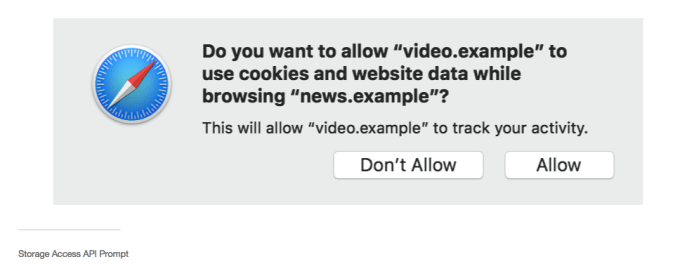
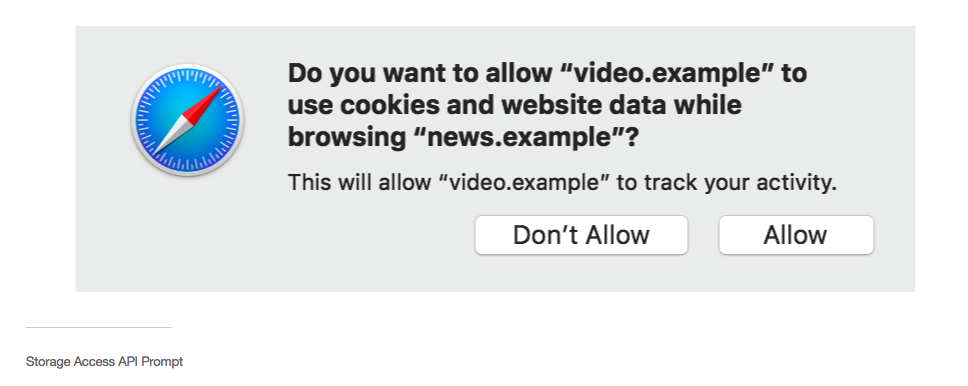
He demoed how Safari will show a pop-up asking users whether or not they want to allow the plugin to track their browsing — letting web browsers “decide to keep your information private”, as he put it.

Safari will also immediately partition cookies for domains that Apple has “determined to have tracking abilities” — removing the 24 window after a website interaction that Apple allowed in the first version of IPT.

It has also engineered a feature designed to detect when a domain is solely used as a “first party bounce tracker” — i.e. meaning it is never used as a third party content provider but tracks the user purely through navigational redirects — with Safari also purging website data in such instances.

Another pro-privacy enhancement detailed by Federighi yesterday is intended to counter browser fingerprinting techniques that are also used to track users from site to site — and which can be a way of doing so even when/if tracking cookies are cleared.

“Data companies are clever and relentless,” he said. “It turns out that when you browse the web your device can be identified by a unique set of characteristics like its configuration, its fonts you have installed, and the plugins you might have installed on a device.

“With Mojave we’re making it much harder for trackers to create a unique fingerprint. We’re presenting websites with only a simplified system configuration. We show them only built-in fonts. And legacy plugins are no longer supported so those can’t contribute to a fingerprint. And as a result your Mac will look more like everyone else’s Mac and will it be dramatically more difficult for data companies to uniquely identify your device and track you.”

In a post detailing IPT 2.0 on its WebKit developer blog, Apple security engineer John Wilander writes that Apple researchers found that cross-site trackers “help each other identify the user”.

“This is basically one tracker telling another tracker that ‘I think it’s user ABC’, at which point the second tracker tells a third tracker ‘Hey, Tracker One thinks it’s user ABC and I think it’s user XYZ’. We call this tracker collusion, and ITP 2.0 detects this behavior through a collusion graph and classifies all involved parties as trackers,” he explains, warning developers they should therefore “avoid making unnecessary redirects to domains that are likely to be classified as having tracking ability” — or else risk being mistaken for a tracker and penalized by having website data purged.

ITP 2.0 will also downgrade the referrer header of a webpage that a tracker can receive to “just the page’s origin for third party requests to domains that the system has classified as possible trackers and which have not received user interaction” (Apple specifies this is not just a visit to a site but must include an interaction such as a tap/click).

Apple gives the example of a user visiting ‘https://ift.tt/2sIGso8;, and that page loading a resource from a tracker — which prior to ITP 2.0 would have received a request containing the full referrer (which contains details of the exact product being bought and from which lots of personal information can be inferred about the user).

But under ITP 2.0, the referrer will be reduced to just “https://store.example/”. Which is a very clear privacy win.

Another welcome privacy update for Mac users that Apple announced yesterday — albeit, it’s really just playing catch-up with Windows and iOS — is expanded privacy controls in Mojave around the camera and microphone so it’s protected by default for any app you run. The user has to authorize access, much like with iOS.


from Social – TechCrunch https://ift.tt/2kPdjnF Read More Detail!

Monday, 4 June 2018

,

Conseris – A data collection app for researchers working in the field


Conseris is a web app designed to help researchers collecting field data to work more efficiently. The app allows users to create customizable collection forms where they can collect and safely store unlimited data. Additionally, the app uses intelligent algorithms to identify patterns and trends in the data to make it easier for the researcher when they begin analysis. It is also easy to share your data with others and to manage multiple projects simultaneously. Finally, the app works with or without wifi making it ideal for work in the field.

View startup


from BetaList - Discover tomorrow's startups, today https://ift.tt/2Lj2kOK Read More Detail!

Facebook’s latest privacy blunder has already attracted congressional ire

The news that Facebook offered to partners until just recently a form of the friend-scraping capability it claimed to have discontinued back in 2014 has, within hours, brought rebuke and a call to action from the House of Representatives.

“It’s deeply concerning that Facebook continues to withhold critical details about the information it has and shares with others. This is just the latest example of Facebook only coming forward when forced to do so by a media outlet,” reads a statement from Rep. Frank Pallone (D-NJ).

Indeed, the question of whether and how a user’s friends’ data was being shared with third parties was brought up during Zuckerberg’s testimony. It is, after all, likely that this is the vector by which millions of users’ data was exfiltrated by agents both malicious and benign.

In the same line of thinking as “don’t talk to the cops,” the CEO was almost certainly instructed not to volunteer any disadvantageous information unless directly asked. Therefore, it should surprise no one that he failed to mention that there existed until quite recently a similar program allowing third parties to collect data on unsuspecting friends.

It’s telling of Facebook’s current predicament that before they can adequately answer some questions, even more arise.

“Our Committee is also still waiting for a lot of answers from Facebook to questions Mr. Zuckerberg could not or would not answer at our hearing,” Pallone said.

He also called for the FTC to get involved: “The Federal Trade Commission must conduct a full review to determine if the consent decree was violated.” I’ve asked if the Representative will be appealing to the FTC directly, and/or whether any existing investigation (the FTC is quiet about these) will be affected.

Pallone is just one among hundreds of senators and representatives, but he is one of the crew responsible for the pending Congressional Review Act rollback of the FCC’s new, weaker net neutrality rules. So it’s not a surprise to see him weigh in quickly on another tech issue. Here’s hoping it helps keep Facebook accountable.


from Social – TechCrunch https://ift.tt/2Jfl6G3 Read More Detail!
,

BookWook – 100% Free Beautiful Website/Blogs for everyone


BookWook lets you create unlimited 100% free high-quality & creative website with BookWook.

Websites, Blogs, E-Commerce, Marketing, Business & a lot more on just one easy platform to help you get online. ✓ No Coding Skills Required ✓ 100% Free* Forever ✓ Awesome Video Tutorials to help you get started ✓ 100% Optimizable & Full Control + Unlimited Possibilities

View startup


from BetaList - Discover tomorrow's startups, today https://ift.tt/2sCD528 Read More Detail!
,

Chatbots Factory – Marketplace for prebuilt Chatfuel and custom-made chatbot 🤖 templates


Chatbots Factory offers affordable chatbots for small and medium-sized businesses. Our chatbots is available in English, Norwegian and Dutch. Delivered within a few hours!

View startup


from BetaList - Discover tomorrow's startups, today https://ift.tt/2Jxbud0 Read More Detail!
,

Kipwise 🔖 – Collaborate on highlights & notes on articles Slack for efficient knowledge sharing


Kipwise allows you to add highlights & notes on articles shared in Slack easily. Sharing a link is not useful if you don’t add your own comment and discuss with your team. Our goal is to provide an easy way to spark a discussion directly in Slack to encourage higher team participation.

Whenever a teammate shares an article in Slack, Kipwise will turn it into a collaboratable version for your team to add annotations. All annotations will be sent back to Slack for easy reference. All shared articles will be saved to your Kipwise dashboard automagically, allowing you to find any shared articles and annotations with ease in the future.

View startup


from BetaList - Discover tomorrow's startups, today https://ift.tt/2HkRZiK Read More Detail!

Sunday, 3 June 2018

,

HungryTripper – Helping travellers with realtime preference based suggestions on a social feed


HungryTripper is a travel app that helps travellers with preference based suggestions across key travel categories. HungryTripper also enables vendors to socially engage/promote offerings to travellers around them.

View startup


from BetaList - Discover tomorrow's startups, today https://ift.tt/2Jgi2cY Read More Detail!
,

VisWiz.io – Flexible visual regression testing service


VisWiz.io is a visual regression testing tool which helps catch unwanted UI changes in your applications and websites.

Don’t let your customers find the bugs before you do!

View startup


from BetaList - Discover tomorrow's startups, today https://ift.tt/2sJjv4v Read More Detail!
,

Inome app – Self-awareness Made Easy


Inome guides you through a daily process of reflection to develop self-awareness, discover who you are, and form new habits to design your life. It guides you through the journey of designing your life step by step.

You just need to reflect on one experience or activity every day. It’s so simple and easy, Inome guides you through a step by step guided process of reflection. As you add more reflections, we will guide you to explore different aspects of you and your life including: - Core Values - Life Balance - Passion - Patterns - Relationship

View startup


from BetaList - Discover tomorrow's startups, today https://ift.tt/2kHX9fM Read More Detail!